Adapt, Shrink, or Die: What the US-OCHA Deal Actually Means
Executive Summary
The Deal: On December 29, 2025, the US signed an MOU with OCHA committing $2 billion to UN humanitarian funds - roughly 85% less than 2024 levels. The deal covers 17 countries. Afghanistan, Yemen, and Gaza are explicitly excluded. UN agencies have been told to "adapt, shrink, or die."
The Abandoned: Around 45 million people in the world's worst crises won't see a dollar of this money. The stated reasons - Taliban diversion, Houthi diversion - would logically exclude half the countries on the included list. The difference isn't operational. It's political.
The Math: $2 billion across 17 countries works out to around $4 per person in need. For context, Sudan alone received $1.9 billion in 2025 and still only managed $61 per person.
The Power Grab: This is the largest donor seizing control of the allocation mechanism. A senior State Department official was explicit: OCHA will now "control the spigot."
The Reality: The US is pledging $2 billion while owing more than $3 billion in unpaid UN dues. As one UN financing expert put it: "It's more show than substance until the funding has actually been disbursed."
What Happened
The Ink Is Barely Dry
As I write this, the MOU is less than 24 hours old. My phone hasn't stopped buzzing since the announcement dropped. Colleagues from three continents asking variations of the same question: What does this actually mean for us?
Here's what we know.
Yesterday, in Geneva, Jeremy Lewin from State and Tom Fletcher from OCHA signed a document committing $2 billion to UN humanitarian funds. Fletcher's quote tells you everything about expectations: "A month ago, I would have anticipated the number would have been zero."
That's where we are. Zero was the baseline. Two billion feels like a win.
But listen to the language from Washington. Rubio called it proof the US "remains the most generous nation in the world." The State Department announced that agencies must "adapt, shrink, or die." Lewin told reporters the old system was "an unaccountable morass of projectized grants." Under the new model, OCHA will "control the spigot."
Adapt, shrink, or die. Control the spigot. The piggy bank is closed.
This isn't partnership. It's an ultimatum.
The Numbers
Let me ground this, because the $2 billion headline obscures more than it reveals.
What the US used to give:
Year US Funding Global Share 2022 ~$18 billion 34% 2024 ~$14.7 billion 33% 2025 ~$3.4 billion 13% 2026 pledge $2 billion maybe 8%
The 2022 peak was driven by Ukraine. But even before that, the US consistently provided $10-15 billion annually. Two billion is roughly 85% below where we were two years ago.
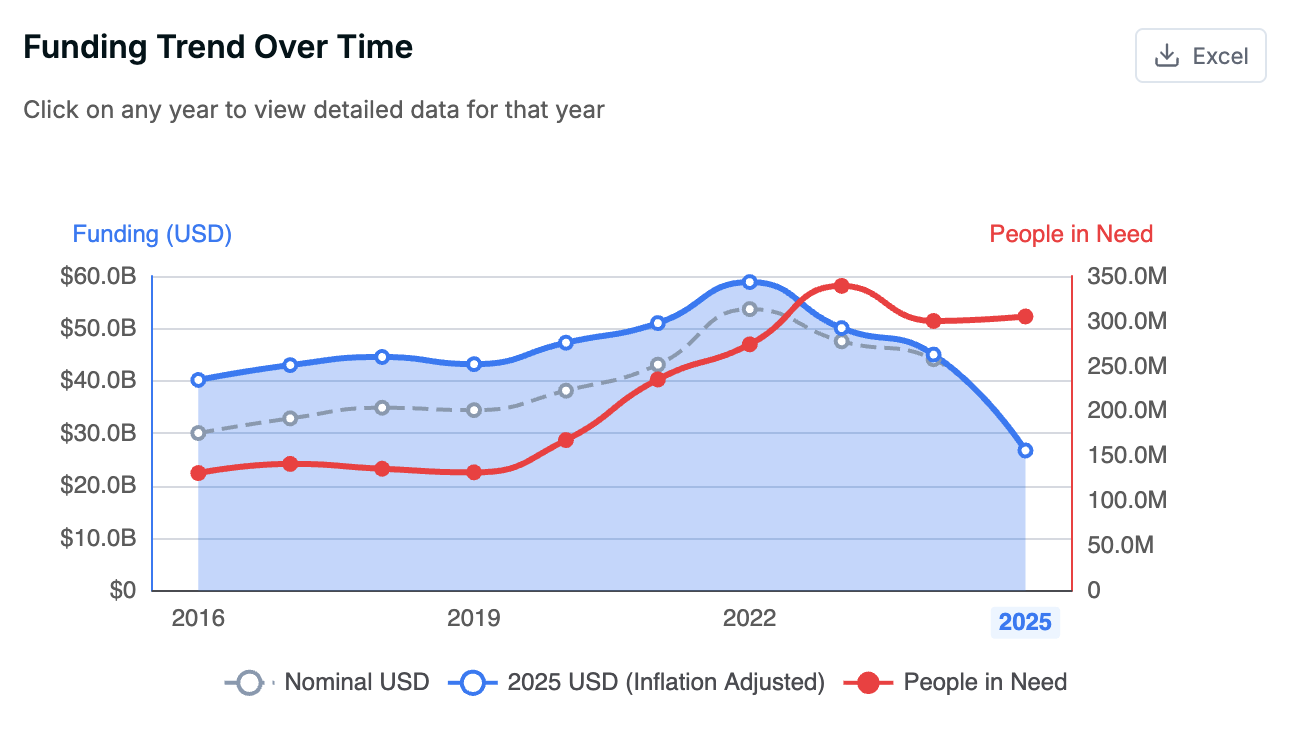
The FTS funding dashboard I've built shows this in stark visual terms: global humanitarian funding peaked at nearly $60 billion in 2022 (inflation-adjusted) while people in need kept climbing to over 300 million. Now funding is collapsing while need keeps rising. The lines have crossed.
data.marketimpact.org
What the US currently owes:
This is where it gets absurd. According to State's own Arrears Report: roughly $1.5 billion in regular budget arrears. Another $1.5-2.4 billion for peacekeeping. Call it $3 billion plus, owed by the country that just pledged $2 billion in humanitarian aid while demanding the UN "reform."
Ronny Patz, who knows UN financing better than almost anyone, posted this within hours of the announcement: "The USA owes more than $2 billion of assessed funding to the UN budget to now pledge $2 billion in UN humanitarian aid, pledges that it will likely not honor unless its demands are met... it's more show than substance until the funding has actually been disbursed."
He's right.
47 Million People Abandoned
Three of the world's worst crises are explicitly excluded from this funding.
Afghanistan. Nearly 23 million people in need. The US gave close to $775 million in 2024. The stated reason for exclusion: a watchdog report found roughly $11 million went to Taliban authorities in taxes and fees.
Do the math. That's a 70-to-1 punishment ratio. For every dollar that went to Taliban taxes, we're cutting seventy dollars in aid to starving Afghans.
Enough. The diversion argument is a pretext.
Yemen. Over 19.5 million in need. US funding to Yemen collapsed from around $800 million in 2024 to about $42 million in 2025, a 95% cut. Now excluded entirely.
Gaza. More than 3 million in acute need. Down from $840 million to $330 million this year. Now excluded, with officials vaguely gesturing toward "Trump's Gaza peace plan", a plan that doesn't exist in any operational form.
Combined, these exclusions represent around 47 million people who will not see a dollar of this money.
The stated reasons, Taliban diversion, Houthi diversion, would logically apply to half the countries on the included list. Armed groups control territory in Sudan. Armed groups control territory in Myanmar. Armed groups control territory in eastern DRC.
The difference isn't operational. It's political.
How this Changes the System
I want to dwell on this phrase because it reveals everything about the structural shift.
Instead of funding agencies directly, the historical model where USAID would provide bilateral grants to WFP, UNHCR, UNICEF, the US is routing everything through OCHA-managed pooled funds. CERF and the Country-Based Pooled Funds.
On the surface, this sounds like good aid practice. Pooled funds enable flexible, needs-based allocation. The Humanitarian Coordinator directs resources to priorities on the ground. OCHA has been advocating for more pooled funding for years.
But context matters.
When pooled funding is a modest share of total resources, the HC can use it to fill gaps. Agencies maintain their core funding through bilateral relationships. The pool is a useful tool, not an existential dependency.
When pooled funding becomes the dominant source from your largest donor, and when that funding comes with "adapt or die" conditions, the dynamic inverts completely. Agencies don't seek allocations. They compete for survival. The HC doesn't coordinate. They control access to resources.
The numbers tell the story. In 2025, total contributions to CBPFs and CERF combined were around $1.3 billion. If this $2 billion flows primarily through those mechanisms, we're looking at a 150% increase in pooled fund volume, but from a single donor with explicit political conditions attached. That's not diversification. That's concentration. That's leverage.
The Cash Question
There's a test case the sector should be watching closely: will this funding be allowed to support cash programming?
Multipurpose cash, giving families money to meet their own needs, has been one of the major programmatic advances of the past decade. The sector spent years building the evidence base, developing the delivery systems, getting donors to trust recipients with agency over their own survival. We fought hard to move USAID toward cash. That institutional knowledge and buy-in walked out the door when the agency was gutted.
Cash is effective. The evidence is overwhelming. But cash is also harder to control. Harder to track at the household level. Harder to ensure it's spent on US-approved activities. It gives recipients agency, which is precisely the point, but agency is harder to brand and harder to claim credit for.
I'm hearing mixed signals from colleagues with visibility into State Department thinking. Cash has featured in some recent rapid response awards, so it's not off the table. But there are reservations. The preference seems to be shifting back toward sectoral programming, food distributions rather than food vouchers, shelter kits rather than rental support.
Watch what happens to cash programming under this model. If multipurpose cash survives and scales, it suggests the US is genuinely interested in effectiveness. If it gets quietly deprioritized in favor of visible, controllable, trackable commodity distributions, then we'll know what "accountability" actually means.
It means control.
What This Means for Agencies
The $2 billion going to OCHA isn't additional funding. It's replacement funding. And it doesn't replace what it's replacing.
In 2024, USAID alone provided over $6.5 billion directly to UN agencies and OCHA-managed funds. WFP, UNHCR, UNICEF, each received substantial bilateral grants that funded their core operations. Multi-year awards that allowed planning. Predictable pipelines that enabled scale.
That pipeline is now closed.
So when the State Department announces $2 billion through OCHA, the question agencies are asking is: what happened to the other $4.5 billion? The answer, as far as anyone can tell, is that it's gone. Not redirected. Not delayed. Gone.
The Infrastructure Nobody Talks About
Here's what gets lost in the funding headlines: humanitarian response isn't just programs. It's infrastructure. Physical, logistical, institutional infrastructure that took decades to build.
WFP doesn't just distribute food. They run the logistics architecture that moves supplies from Mombasa to Juba to distribution points across South Sudan. They operate the UN Humanitarian Air Service. They manage supply chains across some of the most difficult terrain on earth. When funding drops, you don't just reach fewer people. You lose the capacity to reach anyone in certain locations.
UNICEF doesn't just vaccinate children. They maintain cold chains, the unbroken refrigeration from manufacturer to remote health post, that keep vaccines viable. They pre-position supplies. They train health workers. Lose that infrastructure and it doesn't come back quickly.
UNHCR doesn't just register refugees. They operate camps, provide protection, coordinate legal status with host governments. They maintain the relationships with interior ministries and border officials that make access possible. Those relationships are built over years. They collapse in months.
This is what "adapt, shrink, or die" actually means at the operational level. You can't shrink a cold chain by 50% and still have it function. You can't reduce a logistics corridor to skeleton staff and expect it to surge when the next crisis hits. These systems have thresholds below which they simply break.
Easy to Destroy, Hard to Rebuild
We've just watched this happen to USAID itself. A 40-year institution gutted in months. Thousands of staff with decades of institutional knowledge, relationships with implementing partners, understanding of local contexts, gone. Not redeployed. Not restructured. Gone.
The argument was efficiency and reform. The reality is that rebuilding what was lost, if it ever happens, will take a generation.
The same logic applies to the UN agencies now scrambling to understand what this deal means for their 2026 planning. You can destroy institutional capacity quickly. Rebuilding it takes years, sometimes decades. The people who know how to run a vaccination campaign in North Kivu, who have the relationships with armed groups to negotiate access in Darfur, who understand the port logistics in Hodeidah, they don't wait around for funding to return. They move on. They retire. They take jobs in the private sector. And when the money eventually comes back, if it comes back, the knowledge is gone.
This is the part of the "adapt or die" framing that Washington either doesn't understand or doesn't care about. You're not cutting fat. You're cutting muscle and bone. And bodies don't grow that back quickly.
The Math Doesn't Work
Let me show you what $2 billion across 17 countries actually looks like.
The funding versus needs data for 2025 tells a brutal story. Even before this announcement, per-person funding had collapsed to levels that make comprehensive response impossible.
Sudan: $1.9 billion in funding for 30.4 million people in need. That's $61 per person for the year. Down 26% from 2024.
Ethiopia: $883 million for 21.4 million people. $41 per person. Down 47%.
DRC: $752 million for 21.2 million people. $35 per person. Down 53%.
South Sudan: $960 million for 9.3 million people. $103 per person. Down 48%.
Nigeria: $363 million for 7.8 million people. $46 per person. Down 48%.
Haiti: $283 million for 6 million people. $47 per person. Down 36%.
These are the 2025 numbers. These are what the system delivered this year, with funding from multiple donors, including whatever remained of US bilateral support. The results: $35-60 per person annually for most of the world's worst crises.
Now do the math on $2 billion across 17 countries.
$4 Per Person
Divide evenly and you get roughly $118 million per country. That sounds like real money until you look at the caseloads.
Sudan has 30.4 million people in need. At $118 million, that's $3.88 per person. For the year. For food, water, shelter, health, protection, everything.
Ethiopia has 21.4 million in need. At $118 million, that's $5.51 per person.
DRC has 21.2 million in need. At $118 million, that's $5.57 per person.
Of course it won't be divided evenly. Some countries will get more, some less. But that's precisely the point. The pot is so small relative to the need that any allocation decision becomes zero-sum.
Zero-Sum Triage
There are no win-win scenarios here. This is the reality that "prioritization" language obscures.
A dollar going to Sudan is not going to DRC. It's not going to Ethiopia. It's not going to South Sudan. Every allocation is a choice about who gets less. Every increase somewhere is a cut somewhere else.
And these aren't abstract trade-offs. They're decisions about which children get fed. Which displacement camps get clean water. Which health facilities stay open. Which protection programs continue.
The humanitarian system has always involved difficult choices. But there's a difference between prioritizing within adequacy and triaging within scarcity. At $35-60 per person, we were already in scarcity. At $4-6 per person, we're in a different territory entirely.
This isn't humanitarian response. It's palliative care for crises we've decided not to treat.
The Year-on-Year Collapse
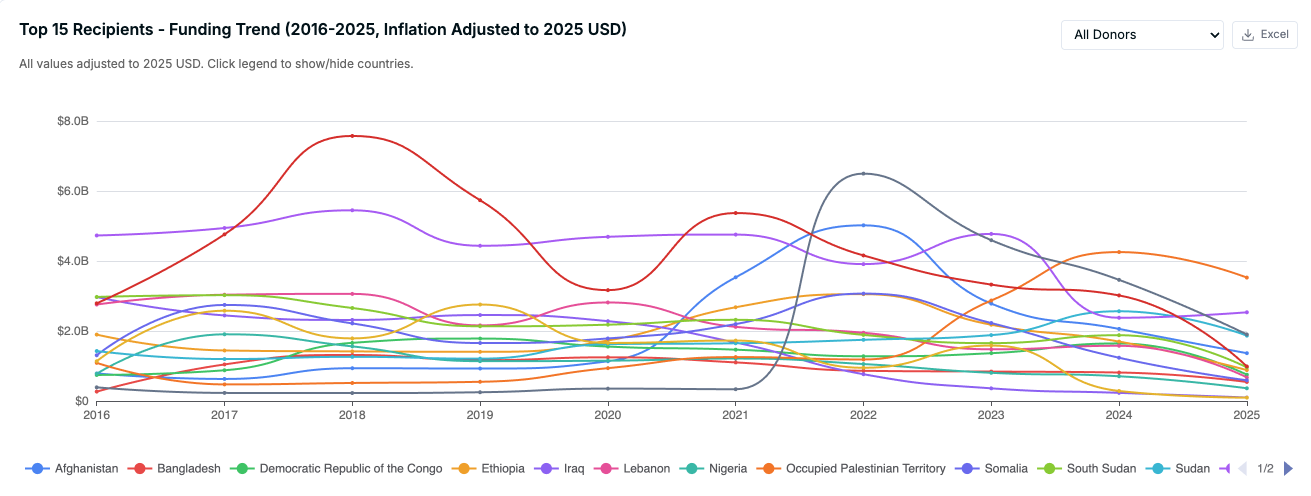
Look at the trajectory. Every major crisis saw funding drop dramatically in 2025:
Sudan: down 26% Afghanistan: down 32% Haiti: down 36% Ethiopia: down 47% South Sudan: down 48% Nigeria: down 48% Somalia: down 51% DRC: down 53% Yemen: down 67%
These cuts happened before the US-OCHA deal. They represent the funding environment into which this $2 billion arrives. The deal isn't filling a gap. It's arriving into a crater.
And here's what makes this worse: the 17 countries in this agreement aren't the only crises. They're just the ones the US has decided to acknowledge. The system still has to respond to everything else, the contexts not on the list, the emergencies that haven't happened yet, with whatever scraps remain from other donors.
The math doesn't work. It can't work. And everyone involved knows it.
data.marketimpact.org
Who Actually Decides?
There's an operational question that nobody has answered yet: who allocates this money?
The announcement says funds flow through OCHA-managed mechanisms, with Humanitarian Coordinators leading allocation decisions based on GHO priorities. That sounds like the system working as designed. HCs on the ground, with visibility into local dynamics, directing resources to where they're most needed.
But the announcement also says the US wants quarterly reviews, strict accountability, geo-tagging of aid delivery, and alignment with US foreign policy. A senior State Department official said OCHA will "control the spigot," but controlling a spigot someone else owns isn't the same as controlling the water supply.
So which is it?
Does Tom Fletcher decide how to divide $2 billion across 17 countries? Does the HC in Sudan decide how much goes to Darfur versus Khartoum versus the east? Or does the State Department have effective sign-off on every significant allocation?
The difference matters enormously.
If HCs have genuine discretion, this could function like pooled funding is supposed to: flexible, responsive, needs-based at country level. The HC sees an emerging cholera outbreak in one state and shifts resources. They identify a protection gap and fund a response. They work with the Humanitarian Country Team to address priorities as they evolve.
If State maintains control, whether formally or through the quarterly review mechanism, then OCHA becomes something else entirely. Not an independent coordinator but an implementing partner for US foreign policy. The HC doesn't lead; they administer. They don't prioritize based on need; they allocate within political parameters set in Washington.
I'm hearing different things from different sources. Some suggest the US will be relatively hands-off once the money is transferred. Others suggest the quarterly reviews will be granular, with State Department officials questioning individual allocation decisions. Nobody seems to know for certain.
And that uncertainty itself is a problem.
Planning in the Dark
Agencies can't plan without knowing how much they'll receive. Country teams can't budget without understanding the allocation process. Implementing partners can't hire staff, pre-position supplies, or negotiate access without some visibility into the funding pipeline.
The $2 billion exists as a headline. It doesn't yet exist as an operational reality. And in humanitarian response, the gap between announcement and implementation is where people die.
We're already at the end of December. Planning for 2026 should be finalized. Instead, agencies are working with spreadsheets full of question marks. How much will come through CERF versus CBPFs? What's the timeline for disbursement? What conditions will be attached at country level? What reporting requirements? What restrictions on implementing partners?
These aren't abstract bureaucratic questions. They determine whether WFP can commit to a feeding program in February. Whether UNHCR can maintain a camp through the dry season. Whether health partners can keep clinics open past Q1.
The uncertainty isn't neutral. It has operational consequences. And those consequences fall on the people waiting for assistance that may or may not arrive.
The Reserve Problem
There's another issue that hasn't been discussed publicly: contingency.
The $2 billion is meant to cover 17 countries for 12 months. But humanitarian funding isn't just about known caseloads. It's about surge capacity. The ability to respond when the unexpected happens.
The next cyclone in Bangladesh. The next cholera outbreak in DRC. The next mass displacement we can't predict. The escalation in a conflict that's currently frozen. The drought that climate models suggest is coming but we don't know when.
CERF exists precisely for this: rapid response to sudden onset emergencies. It's designed to deploy within 72 hours when crisis hits. That speed depends on having money in reserve, money that hasn't already been allocated to known needs.
If a significant portion of this $2 billion flows through CERF, some of it will need to be held back for contingencies. That's not waste or inefficiency. That's how the fund is supposed to work. You can't have rapid response capacity if every dollar is already committed.
$2 Billion Is Less Than $2 Billion
Which means the $2 billion available for planned response in those 17 countries is actually less than $2 billion. How much less? Nobody has said. But any reasonable contingency reserve, enough to mount one or two significant emergency responses, eats into the total substantially.
Call it $1.5 billion for planned programming. Maybe $1.6 billion. Divide that across 17 countries and the per-country allocations shrink further.
And here's the brutal reality check: Sudan alone received $1.9 billion in 2025 and still only managed $61 per person in need. The entire US pledge for 17 countries is less than what one crisis received last year.
The math doesn't just not work at the per-person level. It doesn't work at the system level either.
You cannot run a global humanitarian response on $2 billion. You cannot cover 17 of the world's worst crises with less than what the system spent on one of them last year. You cannot maintain surge capacity while also meeting baseline needs with a pot this small.
Everyone involved knows this. The question is whether anyone will say it publicly, or whether we'll continue pretending that "prioritization" and "efficiency" can bridge a gap this large.
They can't.
Why This Happened
The End of the Peace Dividend
To understand what's happening now, you have to understand what enabled the system we're losing.
The modern humanitarian sector didn't grow because the world became more generous. It grew because the Cold War ended.
In 1998, total global humanitarian funding was around $7 billion. By 2022, it had reached $46 billion. That six-fold expansion didn't happen by accident. It happened because Western governments had fiscal space they didn't have before, and political incentives to use it.
When the Soviet Union collapsed, defense budgets across NATO dropped dramatically. The "peace dividend" was real. Money that had been allocated to tanks and missiles and nuclear arsenals got redirected. Some went to tax cuts. Some went to domestic programs. And some, a meaningful slice, went to international solidarity. Development. Humanitarian response. Global health.
The humanitarian sector was built on that fiscal foundation. Every major expansion, the growth of WFP, the scaling of UNHCR, the creation of OCHA itself, happened during the peace dividend years. The architecture we now treat as permanent was actually the product of a specific geopolitical moment. A moment that has now ended.
The Dividend Is Over
Look at what's happening to defense budgets.
NATO is now targeting 5% of GDP for military spending. Not 2%, the target most members weren't even meeting. Five percent. Germany is rearming at a pace not seen since reunification. The UK is increasing defense spending while cutting everything else. The US defense budget has crossed $900 billion and continues to climb.
This is military spending at levels not seen since the Cold War. And it's being funded by the same treasuries that used to fund humanitarian response.
The fiscal math is unforgiving. When debt-to-GDP ratios are already above 100% in most Western economies, and when defense spending is surging, something has to give. Humanitarian funding is what's giving.
This isn't about ideology, though ideology plays a role. It's about arithmetic. The fiscal space that enabled the humanitarian sector's growth simply doesn't exist anymore. Western governments are making choices about where limited resources go, and humanitarian response is losing.
This Isn't Just Trump
It's tempting to frame the current collapse as a Trump administration story. The rhetoric certainly is. "Adapt, shrink, or die" isn't language you'd hear from previous administrations.
But the funding trajectory predates Trump.
Sixteen of the twenty largest humanitarian donors cut their contributions in 2024, before Trump took office. Germany cut. The UK cut. France cut. The pattern was already established.
Trump has accelerated the collapse, made it more explicit, and added the political conditions that transform a funding cut into a structural restructuring. But he didn't start it. He's surfing a wave that was already building.
The underlying driver is the same across all these contexts: the post-Cold War fiscal settlement is unwinding. The period when Western governments had surplus capacity for international solidarity is over. What we're witnessing isn't a policy choice that a different administration would reverse. It's a structural shift in how Western governments allocate scarce resources.
That's not a reason to stop fighting. But it is a reason to stop expecting the old funding model to return.
The Compact Is Broken
For those following this series: I've written before about how the GHO transformed from accountability document to triage manual. I won't repeat that analysis here. But the US-OCHA deal makes explicit what was previously implicit.
For thirty years, the humanitarian system operated under an unwritten compact. Agencies would assess need comprehensively. Donors would fund proportionally. The gap would be transparent and subject to advocacy. Resolution 46/182 encoded this expectation. The Good Humanitarian Donorship Principles reinforced it.
That compact is now formally dead. December 29 is the death certificate.
The Global Humanitarian Overview for 2026 identifies 250 million people in need. OCHA is targeting 87 million. The funding ask is $23 billion, down from $47 billion.
This isn't prioritization within a needs-based framework. The framework itself has been abandoned. OCHA is pre-emptively shrinking the definition of need to match donor appetite. The GHO has transformed from a document that told uncomfortable truths about the gap between need and response into an operational manual for managed abandonment.
Death by Non-Compliance
Here's what's important to understand: none of the foundational commitments have been formally rescinded.
No donor government stood up and declared they were withdrawing from the Good Humanitarian Donorship Principles. No General Assembly resolution rewrote 46/182. No global forum issued a statement saying needs-based allocation is no longer the backbone of humanitarian action.
The commitments still exist on paper. They're still cited in speeches. Still referenced in policy documents. Still printed in frameworks that gather dust on shelves.
But donor behavior drifted steadily, and then dramatically, away from the norms they once endorsed.
The retreat didn't come through announcement. It came through non-compliance.
Donors simply stopped writing checks, and waited for the system to adapt around their silence. That isn't a funding gap. That's a political choice dressed up as fiscal constraint. And the GHO 2026 is the moment that choice became structurally embedded in the system's core planning document.
Until yesterday, the abandonment was implicit. The US-OCHA deal makes it explicit. Washington is no longer quietly underfunding the system. It's actively restructuring it. Funding will flow according to political preference. Countries will be included or excluded based on geopolitical alignment. Agencies will comply with reform conditions or lose access to the spigot.
This is what the end of needs-based response looks like when it stops pretending.
Why This Won't Self-Correct
Some will hope this is temporary. A political cycle. A pendulum that will swing back.
I don't think so. Here's why.
Polling consistently shows public support for aid remains relatively high. In the UK, only around a third of voters actively support cuts. Support for maintaining aid has been surprisingly stable even through successive rounds of reductions.
But there's no organized constituency defending the system.
The attack on humanitarian funding is loud, sustained, and politically rewarded. Media proprietors campaign against it. Politicians score points by cutting it. Social media amplifies every scandal, every inefficiency, every story that confirms the narrative that aid is wasted.
And outside of people paid by the sector, almost nobody is actively defending it. No marches. No swing votes. No political price for retreat. No politician has ever lost an election because they cut humanitarian funding.
Passive public goodwill doesn't counter concentrated opposition. Diffuse support versus organized attack. The organized attack wins. Every time.
The Elite Consensus Has Fractured
The compact held for thirty years not because of popular demand, but because of elite consensus. Foreign policy establishments in Washington, London, Berlin, and other capitals believed humanitarian funding served their interests. Soft power. Stability in fragile regions. Migration management. Counter-terrorism cooperation.
That consensus has fractured.
The generation of policymakers who built the post-Cold War order is aging out. The new generation doesn't share the same assumptions about America's role in the world, or Europe's obligations, or the value of multilateral institutions. The think tanks and foreign ministries that used to advocate for humanitarian funding are now focused on great power competition, defense partnerships, and industrial policy.
The domestic political coalition that supported international engagement has collapsed in both parties in the US, and is fragmenting in Europe. There's no constituency pushing back when humanitarian funding gets cut. The space it occupied in elite discourse has been filled by other priorities.
The Precedent Problem
This is why the $2 billion matters beyond its immediate operational impact. It's not just a funding level. It's a template.
Other donors are watching. If this model works for the US, if OCHA accepts the conditions, if agencies adapt and the system keeps functioning, then this becomes the new normal. The proof of concept for how major donors can restructure multilateral humanitarian response to serve their political preferences.
The quarterly reviews. The political exclusions. The "adapt or die" ultimatum. The centralized control through pooled funds. If it works here, it will be replicated.
And conversely, the 47 million people in Afghanistan, Yemen, and Gaza aren't just excluded from this deal. They're excluded from the precedent it sets. Their abandonment isn't an exception. It's the new rule being written.
The window for challenging this template is now. Once it becomes normalized, once other donors adopt similar frameworks, the architecture of needs-based response will be gone. Not suspended. Gone.
And everyone waiting for the political winds to shift and the old model to return will be waiting for something that isn't coming back.
What Comes Next?
What I'm Watching
The announcement creates more questions than answers. Here's what I'm tracking over the coming weeks:
Does the money actually show up?
A pledge isn't a disbursement. The same Congress that passed $1 billion in rescissions this year, that has capped peacekeeping for three decades, has to appropriate this. The FY2026 budget proposes 83% cuts to international organization contributions. The environment is hostile.
Do other donors compensate?
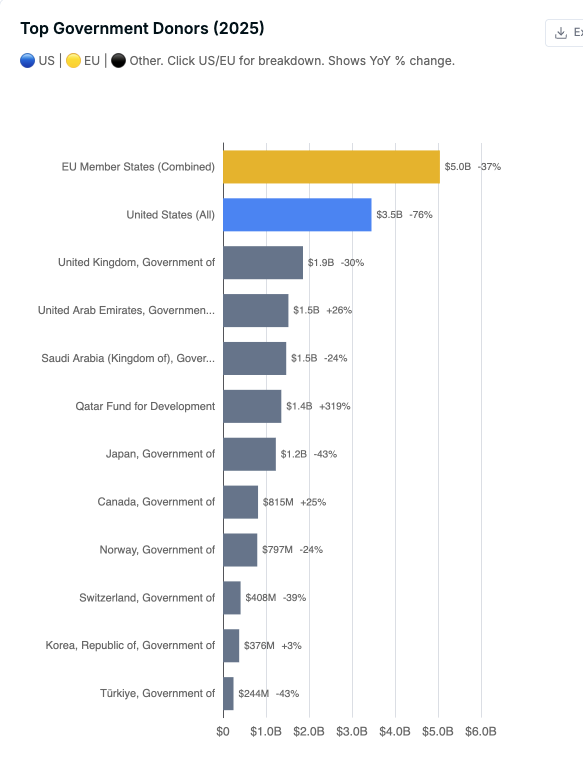
Germany is cutting. The UK is cutting. The fiscal pressures apply across the traditional donor base. The dashboard's donor comparison tells the story: US down 76%, UK down 30%, Japan down 43%. The only bright spots are Gulf states, UAE up 26%, Qatar up 319%—but they give bilateral, heavily earmarked funds, not the flexible support multilateral response requires.
Most likely outcome: nobody compensates. The system contracts further.
data.marketimpact.org
No Good Answers
Before I get to options, I want to be direct about where this leaves us. Because there's a conversation we need to have that isn't happening in the reset discussions, the IASC meetings, the closed-door negotiations in Geneva.
We need to name who we're abandoning. And we need to define what we're even talking about.
I started my career in South Sudan in 2011. When pipeline breaks happened, when the food kits didn't get through, we had to make choices. Hard choices. You looked at a malnourished child and you calculated: is this one too far gone? Is the therapeutic feeding better used on someone who might survive? You made a choice between people who lived and people who died.
Those decisions are being made right now. In Sudan. In Gaza. In Myanmar. In Chad. In Yemen. The people at the front line are already doing the triage that policymakers in Geneva and Washington refuse to acknowledge.
There are no win-win scenarios here.
What Are We Even Talking About?
Here's a question that should be simple but isn't: what is humanitarian assistance?
The sector has never clearly defined its boundaries. Is it life-saving emergency response, the classic image of food drops and field hospitals in acute crisis? Is it the protracted support we've been providing for decades in places like Kenya, Bangladesh, Jordan, where "emergency" became permanent? Is it the development-adjacent programming that UNICEF does toward sustainable development goals? Is it protection work that doesn't deliver commodities but prevents harm?
We've been able to avoid this question because funding was generous enough to cover the ambiguity. That's over.
If we're honest, the triage is already falling back to the narrowest definition: emergency aid, life-saving assistance, provision of last resort. The 2-3 month response to acute crisis. Get people through the immediate shock, then hand over to someone else.
But here's the problem: who is "someone else"?
The Handover That Doesn't Exist
The humanitarian system was designed as a bridge. Emergency response that stabilizes a situation until development actors, governments, longer-term funding can take over.
That bridge has become a permanent residence because the other side never materialised.
In theory, protracted situations should transition to UNDP-led government support, to development programming, to resilient national systems. In practice, those transitions rarely happen. Governments lack capacity or willingness. Development funding has its own crises. The nexus everyone talks about remains mostly theoretical.
So we've been funding "emergencies" in some countries for 20, 30, 40 years. Generations have grown up in camps that were supposed to be temporary. Humanitarian budgets have absorbed what should have been development programming. And now, when the money disappears, there's nothing underneath.
The honest conversation we need to have: protracted emergencies will not be funded at current levels. Probably ever again.
That's not a policy choice we can reverse with advocacy. It's a structural reality. The fiscal space doesn't exist. The political will doesn't exist. The 47 million people excluded from this deal, many of them have been receiving humanitarian assistance for years. They're not going to get it anymore. And there's no development system ready to catch them.
A Smaller, Sharper System
If we're being brutally realistic about 2026 and beyond, we're probably looking at a humanitarian system that is:
Smaller. Not 250 million people in need. Not 87 million targeted. Something closer to rapid response capacity for acute emergencies, measured in weeks and months rather than years and decades.
Sharper. Clearly defined as life-saving intervention in acute crisis. Food, water, emergency shelter, basic medical care. Not protection mainstreaming. Not resilience programming. Not the thousand things we've layered onto the humanitarian mandate over the years.
Faster to hand over. Two to three months of emergency response, then transition to whatever exists, government systems, development actors, local organisations, community networks. Even when what exists is inadequate. Because the alternative, permanent humanitarian presence, is no longer fundable.
This is a dramatic contraction from what the system has become. It means abandoning the protracted caseloads. It means accepting that millions of people in stable-but-poor situations will no longer receive international humanitarian support. It means the Kenyas and Bangladeshes and Jordans of the world becoming someone else's problem, or no one's problem.
I'm not saying this is right. I'm saying this is where we're heading whether we choose it or not.
The Frameworks That No Longer Apply
And if this is where we're heading, we need to be honest that some of the frameworks we've built no longer apply.
The Grand Bargain. Does it exist? The US government has explicitly said sustainable development goals are against US policy. The commitments made in 2016 assumed a funding environment that no longer exists and donor relationships that have fundamentally changed.
The nexus. Humanitarian-development-peace. A lovely triangle that assumes all three legs have resources. When humanitarian funding collapses and development funding is also under pressure, the nexus becomes two broken systems pointing at each other.
Localisation. We've been talking about shifting power to local actors for a decade. In theory, this moment should accelerate that. In practice, local organisations need funding too. And when international funding dries up, the resources that were supposed to shift don't exist to shift.
These aren't sacred texts. They were frameworks for a particular moment. That moment has passed.
Structural Collapse, Not a Funding Cycle
The humanitarian reset frames this as a crisis to manage through. I'd push back on that framing.
This isn't a cycle. It's a structural collapse. And the response to structural collapse isn't optimization. It's honesty about what we can no longer do.
We have to be able to say: we are abandoning these people. We are leaving this country. We are shutting down this program. Not because we want to. Because we have no choice.
That conversation isn't happening. Instead we get "prioritization" language that obscures the reality of triage. We get "efficiency" framing that pretends you can do more with less indefinitely. We get "reset" rhetoric that implies we're adjusting when we're actually retreating.
The fiction that everything can continue has to end.
Too Many Fires, Not Enough Engines
Right now, there are too many fires being left to burn. And we're about to lose the fire engines themselves.
The logistics capacity. The cold chains. The airlift infrastructure. The institutional knowledge that makes response possible. These systems have thresholds below which they simply break. We're approaching those thresholds.
That food kit that got to someone in Sudan? It needed an airlift. It needed a logistics train. It needed huge amounts of coordination across multiple organizations. It wasn't sourceable from the local market. These aren't programmes you can scale up and down like a tap. They're infrastructure. And infrastructure, once lost, takes years to rebuild.
If we don't make hard decisions about where to focus, we won't just fail to reach everyone. We'll lose the capacity to reach anyone in certain contexts. The choice isn't between helping everyone and helping some people. The choice is between deliberate triage and chaotic collapse.
The Challenge
So here's my challenge to everyone reading this.
Stop pretending there are good options. There aren't. There are bad options and worse options. The question is whether we choose deliberately, with transparency about what we're sacrificing, or whether we let the system collapse chaotically while maintaining the fiction that prioritization is happening.
2026 will force this conversation whether we want it or not. Better to have it honestly now than to pretend we can avoid the choices that are already being made.
I've talked to colleagues who say this is too dark. That we need hope. That we need to focus on what's possible rather than what's lost.
I understand that impulse. But false hope isn't kindness. It's cowardice. The people in Sudan, in Yemen, in Afghanistan, they don't need us to feel hopeful. They need us to be honest about what's happening and why. They need us to name the failures, even when it's uncomfortable. Especially when it's uncomfortable.
The humanitarian system has always involved difficult choices. But there's a difference between prioritizing within adequacy and triaging within scarcity. We've crossed from one to the other. The sooner we acknowledge that, the sooner we can have an honest conversation about what comes next.
Two Options? Not Really.
Let me be honest. I've seen a lot of commentary framing this as a choice between two paths. Managed decline versus building something new. Working within the system versus burning it down.
I don't think that's accurate. There isn't really a second option. Not in any meaningful timeframe.
The Western-dominated, UN-centered humanitarian system is what we have. The infrastructure exists. The relationships exist. The institutional knowledge, diminished as it is, still exists. The idea that we can quickly pivot to regional mechanisms, diaspora networks, and local-first response sounds appealing in conference panels. In practice, those alternatives aren't ready to absorb the caseload. They're not funded. They're not scaled. They're not coming to rescue us in 2026.
So we're left with one option: make the existing system work as well as it possibly can with dramatically fewer resources.
That's not inspiring. But it's true.
What We Can Actually Do
Within that constraint, there are practical things that can make a difference. Not transformational. Not revolutionary. But real.
Find the efficiencies we've been too comfortable to find.
The humanitarian sector has accumulated layers of process, overhead, coordination theatre, and bureaucratic duplication that we tolerated when funding was generous. That tolerance is now a luxury we can't afford.
This doesn't mean cutting corners on accountability. It means asking hard questions about where money actually goes. How many layers sit between a donor dollar and a beneficiary? How much time do field staff spend on reporting versus response? How many coordination meetings produce documents that nobody reads?
There are genuine efficiencies to be found. We just haven't been forced to find them until now.
Use AI responsibly to increase productivity.
And I mean responsibly. Not to replace human judgment in life-and-death decisions. Not to automate the choices that require context, relationships, and ethical reasoning.
But there's enormous scope to use AI for the boring busy work. The proposal writing. The reporting. The data cleaning. The translation. The logistics optimization. The supply chain management. The endless administrative tasks that consume field staff time that should be spent on response.
If we can free up 20% of programme staff time by automating paperwork, that's 20% more capacity for actual humanitarian work. The technology exists. We're just not using it systematically.
Combine logistics and supply chains.
This has been talked about for years. WFP running supply chains that serve multiple agencies. Shared warehousing. Consolidated procurement. Common logistics platforms.
It's happened in some contexts. It hasn't happened systematically. The institutional incentives have always pushed toward agency-specific supply chains, agency-specific branding, agency-specific visibility.
Those incentives are now unaffordable. If three agencies are running parallel logistics corridors into the same location, that's waste we can't justify. Consolidation won't be popular. It will threaten institutional identities. But it's necessary.
Expand the use of cash transfers.
I've already raised the question of whether this funding will support cash programming. But let me be clear about why it matters.
Cash transfers are cheaper to deliver than commodities. No warehousing. No transport of physical goods. No last-mile distribution costs. The evidence base is overwhelming: cash works as well or better than in-kind assistance for most needs.
Cash is more efficient. More dignified. It gives recipients agency over their own survival. It lets people make decisions about their own priorities rather than receiving whatever we've decided they need.
If we're serious about doing more with less, cash should be the default modality wherever markets function. The resistance to cash has always been partly about control, partly about visibility, partly about institutional interests in commodity pipelines. Those concerns are now luxuries.
Every dollar that goes to trucking food that could have been purchased locally is a dollar that isn't reaching someone else.
The Limits of Efficiency
But I want to be clear-eyed about what efficiency gains can and cannot do.
They cannot close a gap this large. You cannot efficiency your way from $14 billion to $2 billion. The math doesn't work. No amount of AI, logistics consolidation, or cash programming is going to make $118 million per country adequate for crises that need billions.
Efficiency gains might get us 10%, maybe 20% more impact per dollar. That matters. That's lives saved. But it's not transformation. It's not a solution to the structural collapse we're facing.
So we should pursue every efficiency available. And we should be honest that it won't be enough. Both things are true.
What We Cannot Do
We cannot pretend the old system is coming back. The fiscal and political conditions that enabled $46 billion in humanitarian funding no longer exist. Waiting for the cycle to turn is not a strategy.
We cannot pretend that efficiency alone will bridge the gap. It won't. People will die who wouldn't have died with adequate funding. That's the reality.
We cannot pretend that hard choices aren't being made. They are. Every day. In every country office. By people who don't have the luxury of ambiguity. The least we can do is acknowledge what they're facing.
And we cannot stop bearing witness. Even when we can't respond, we can document. We can count. We can name. The 47 million people excluded from this deal don't become invisible just because we can't help them. We owe them at least the dignity of being seen.
The Failure of Witness
There's something at stake here beyond operational capacity. Something that gets lost when we focus only on funding and programming.
The humanitarian system has always had a dual function: response and witness.
We respond to crises. We deliver assistance. We try to keep people alive. That's the operational mandate.
But we also bear witness. We document suffering. We count the dead, the displaced, the hungry. We name what is happening and who is responsible. We create the historical record that holds power accountable, even when that accountability comes too late to help.
The Global Humanitarian Overview was part of that witness function. It said: here is the totality of need. Here is what the world requires. Here is the gap between what is needed and what is provided. Here are the people we are failing.
When the GHO becomes "realistic," when it calibrates to donor appetite rather than human need, that witness function dies. We stop documenting the gap. We stop naming the failure. We stop creating the record.
The 47 million people in Afghanistan, Yemen, and Gaza don't disappear from reality when they're excluded from this funding. Children are still malnourished. Families are still displaced. Hospitals are still running out of medicine.
But they disappear from the humanitarian aperture.
The record of their suffering, the accounting of what was needed and what was provided, gets erased before it's even written. Not because we don't know they're suffering. Because we've decided, collectively, to stop looking.
We can acknowledge we don't have resources to respond while still documenting the need. We can admit we're not reaching people while still counting them. We can accept the limits of our capacity while refusing to accept the limits of our witness.
That's the minimum. That's the floor. And right now, even that is under threat.
What I Need From You
If you're reading this, you probably have information I don't.
From field practitioners: What decisions are being made at country level right now? What's actually happening to programming? What's being cut, what's being maintained, what's disappearing without announcement? Send me specifics. Not for attribution if you prefer.
From agency staff: How is your organization positioning? What's the internal conversation about efficiency versus cuts? About what can be consolidated and what can't? I want to understand what's realistic.
From tech colleagues: What's actually working with AI in humanitarian contexts? Not the pilot projects and innovation labs. The practical applications that are saving time and money at scale. Share what you're seeing.
From affected communities and local organizations: How are you experiencing this? What would actually help? What are international actors getting wrong? Your voice has been absent from this conversation for too long.
This isn't academic for me. The decisions made in Geneva and Washington this week will determine how many kids get turned away from therapeutic feeding centres. How many families don't get the cash transfer that would have kept them housed. How many communities lose access to the health clinic that was their only option.
I want to understand what's actually happening. Not the official narrative. The ground truth.
Reach out. Comment below. Send me a message. Share what you're seeing.
Where This Leaves Us
The US has stated its position. Adapt, shrink, or die.
I don't accept that framing. But I accept the reality underneath it.
The funding isn't coming back. The system will be smaller. Hard choices will be made, are being made, have already been made. People will suffer who didn't have to suffer. People will die who didn't have to die.
Within those constraints, we can fight for every efficiency. We can push for cash over commodities. We can use technology to reduce waste. We can consolidate where consolidation makes sense. We can protect the logistics infrastructure that makes response possible. We can maintain the witness function even when we can't maintain the operational footprint.
And we can be honest. With ourselves. With affected populations. With the public. About what's happening and why. About who made these choices and what they cost. About the gap between what's needed and what's provided.
The humanitarian system isn't the victim here. The people who depend on it are.
Let's at least be honest about that. And let's do what we can with what we have.
Thomas Byrnes is CEO of Market Impact. He has worked on humanitarian response in South Sudan, Yemen, Ukraine, and across the Middle East and Asia. He recently discussed the funding crisis on theTrumanitarian podcast.
#HumanitarianAid #OCHA #UnitedNations #USAid #HumanitarianReform #FundingCrisis #CashTransfers #HumanitarianResponse
Sources:
FTS Funding Dashboard: https://data.marketimpact.org/
State Dept Arrears Report: https://www.state.gov/wp-content/uploads/2025/09/Tab-2a-Arrears-Report-Detail-January-2025-Accessible-09.25.2025.pdf
Pew Research: https://www.pewresearch.org/short-reads/2025/07/31/how-the-united-nations-is-funded-and-who-pays-the-most/
Enjoyed this article?
This post is from Aid and Dev Dispatches, a LinkedIn newsletter with expert analysis on humanitarian reform, AI adoption, crisis economics, and the politics of aid. Join 9,000+ subscribers.