Breaking: UN80 Signals Major Humanitarian Agency Consolidation - What the Secretary-General's Briefing Reveals About the Future of Aid
Executive Summary
Consolidation on the Table: Secretary-General Guterres explicitly mentioned "exploring combinations of OCHA, UNHCR, IOM, and WFP functions" in yesterday's UN80 briefing - the first official signal that merging humanitarian functions is being considered.
Financial Reality Driving Reform: This proposed consolidation reflects the deepening funding crisis I've documented in previous posts, with the UN80 initiative aiming to create a more efficient system that could help "limit the impact of the liquidity crisis."
Reform Through Clusters: A new high-level "humanitarian cluster" coordinated by five major agencies will drive this process, potentially resolving long-standing coordination failures that have cost hundreds of millions in duplicated aid.
Yesterday's UN General Assembly briefing by Secretary-General António Guterres provided the first concrete insights into how the UN80 initiative could reshape humanitarian architecture. While details remain limited, the formation of a dedicated "humanitarian cluster" and explicit mention of combining agency functions marks a potential inflection point for a system already reeling from unprecedented funding cuts.
"They will be the locomotive force for concrete proposals, and they will operate at the high level of ambition that our times demand," Guterres stated about the newly formed clusters, signaling his determination to drive meaningful change.
Current Inefficiencies Exposed by Data
The scale of current inefficiencies justifies this reform approach. In Ukraine alone, the Building Blocks deduplication system eliminated $230 million in savings for cash assistance in a single crisis context through 2022-2024 (OCHA Ukraine, Cash Working Group Snapshots, 2023-2024). This staggering figure represents just one symptom of a humanitarian system that maintains parallel operational systems serving institutional interests rather than optimal results.
As I detailed in my "No More Self-Delusion" post last week, these inefficiencies aren't merely administrative annoyances – they directly impact our ability to reach people in crisis. Jan Egeland and Joyce Msuya (2024, p.1) put it bluntly in their recent proposals: "The current humanitarian system is overly complex, bureaucratic, and resistant to change, leading to inefficiencies and delays in delivering aid to those who need it most."
With UN agencies announcing dramatic cuts (WFP cutting 25-30% of staff, OCHA 20%), addressing systemic fragmentation has become an existential necessity, not just an aspirational goal.
Visualizing the Duplication and Potential Consolidation
To better understand what's at stake, I've created two visualizations illustrating both the current system duplications and what a potential consolidated future might look like under UN80 reforms.
The first image maps the current state of overlapping services across UN agencies. While these agencies have distinct mandates, in practice they frequently deliver similar basic services through parallel systems – from multiple agencies distributing nearly identical NFI packages to the same communities, to overlapping cash programs with separate targeting, registration, and distribution mechanisms. These duplications manifest in redundant processes for beneficiary registration, needs assessments, data management, logistics, and coordination – all creating inefficiencies that ultimately reduce aid reaching affected populations.
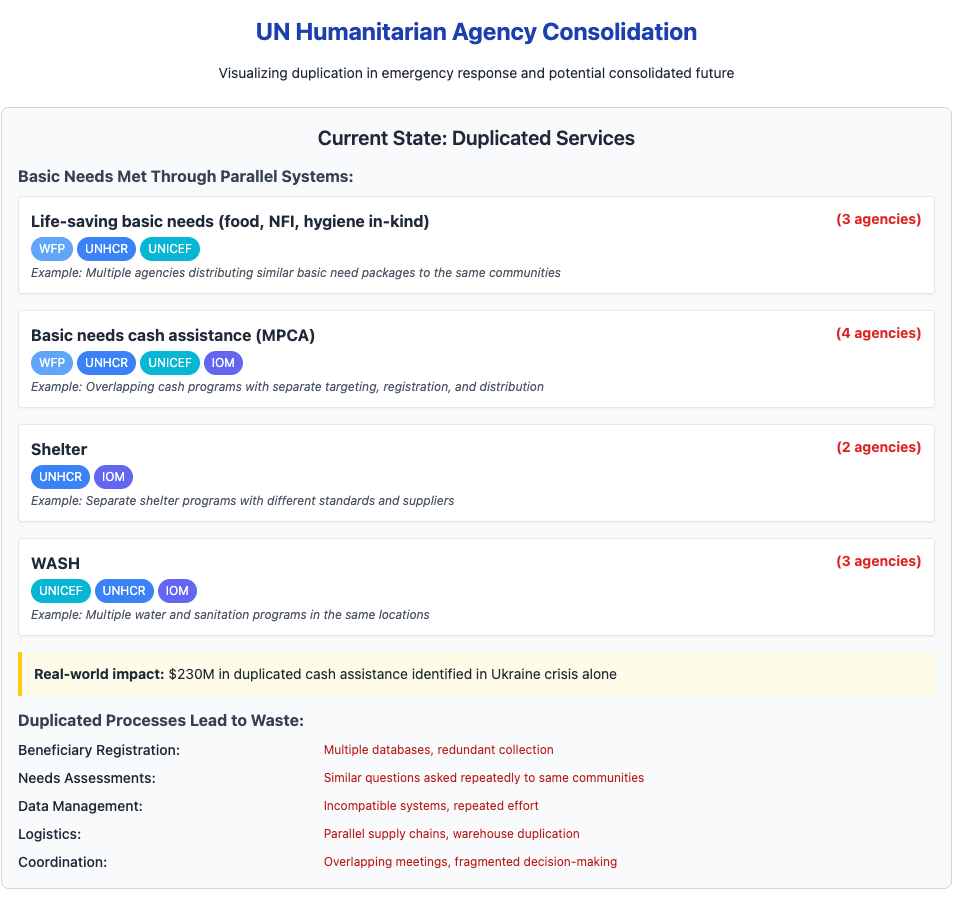
Figure 1: Mapping the Current Duplication in UN Humanitarian Response. Source: Author's analysis based on operational humanitarian data.
The second visualization offers one interpretation of how the UN80 humanitarian cluster might approach consolidation. Rather than eliminating agencies, this model suggests integrating key functions like beneficiary registration, basic needs response, supply chains, coordination, and reporting. Such consolidation could yield significant benefits for both affected communities and system efficiency while preserving the specialized expertise each agency brings.
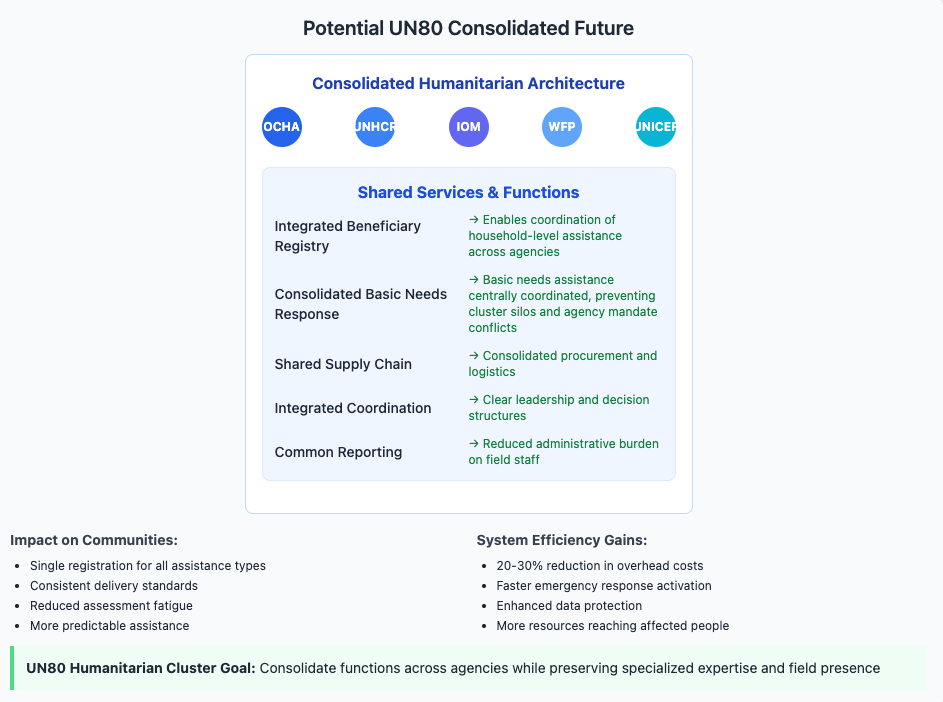
Figure 2: A Possible UN80 Consolidated Future. This model illustrates how agencies could maintain their distinct identities while integrating core functions like beneficiary registration, basic needs response, and logistics to improve efficiency and community outcomes. Source: Author's interpretation of potential UN80 reform directions.
These visualizations are my analysis based on the Secretary-General's briefing and sector discussions, not official UN80 proposals. However, they help concretize the opportunities and challenges ahead as the humanitarian cluster begins its work.
The Humanitarian Cluster: Reform Through Coordination
The Secretary-General's approach creates a high-level coordination mechanism specifically designed to identify inefficiencies, review mandate implementation, and propose structural changes. Unlike the traditional humanitarian cluster system that organizes response by sectors, this reform cluster brings together:
Emergency Relief Coordinator (head of OCHA)
World Food Programme (WFP)
United Nations Children's Fund (UNICEF)
UN High Commissioner for Refugees (UNHCR)
International Organization for Migration (IOM)
This structure represents a significant departure from the existing humanitarian cluster approach, which according to the Leadership in Humanitarian Action Handbook (2024, p.59) aims to "coordinate the delivery of assistance among the various actors working in specific sectors." The new UN80 cluster instead focuses on cross-cutting structural reform of the agencies themselves.
This group will now examine how these agencies can work more efficiently together, potentially through consolidating certain functions, eliminating duplications, and streamlining operations. The Secretary-General emphasized they would be "the locomotive force for concrete proposals."
Member State Reactions: Mixed Signals
Member state responses during the briefing reflected diverse priorities and concerns:
The G77 and China (via Iraq) warned that "any proposal aimed at achieving efficiencies... should not aim to dismantling the UN agencies and funds" and emphasized that "regional commissions... need to be strengthening and not diminished."
Meanwhile, the EU highlighted the need for "evidence-based decision-making" and requested "detailed data across the UN system on mandate implementation processes, performance, and cost structures."
The Alliance of Small Island States (AOSIS) voiced concerns that reforms "must not lead to the withdrawal or reduction of UN presence in SIDS," stressing that "in-country and regional presence is essential."
These reactions suggest the reform process will face significant political navigation challenges despite general recognition that change is necessary. As the Secretary-General himself stated: "Make no mistake, uncomfortable and difficult decisions lie ahead. It may be easier and even tempting to ignore them or kick the can down the road. But that road is a dead end."
Historical Context: Why This Time Might Be Different
Previous reform efforts like the 2016 Grand Bargain, the 2005 Humanitarian Reform Initiative, and the 2010 Transformative Agenda achieved incremental improvements but failed to address fundamental structural inefficiencies. What makes UN80 different is timing and leverage:
Financial Imperative: Unlike previous reforms driven by aspirational goals, UN80 emerges from acute financial necessity as major donors cut funding dramatically.
Institutional Backing: The Secretary-General has established a dedicated task force and placed his personal authority behind this effort.
Broader UN Reform Context: UN80 encompasses the entire UN system, creating momentum that previous humanitarian-specific reforms lacked.
As Jan Egeland and Greta Msuya noted in their recent proposals (cited in my "No More Self-Delusion" post), the current humanitarian system is "overly complex, bureaucratic, and resistant to change." The liquidity crisis might finally provide the catalyst that breaks institutional inertia.
Field Implications: How Consolidation Could Change the Ground Game
If OCHA, UNHCR, IOM, and WFP functions are indeed combined, frontline operations could see transformative changes in how aid reaches affected people. Here's how this might play out in three critical contexts:
Emergency Response Coordination: From Fragmentation to Integration In displacement settings like Bangladesh's Rohingya camps, the current system operates with bewildering complexity: UNHCR manages refugee registration but WFP handles food assistance biometrics, while UNICEF coordinates education and WASH interventions with separate databases. According to a 2023 joint evaluation by the IASC, field coordinators reportedly spend 20-30% of their time reconciling data across these systems rather than addressing urgent operational needs.
Functional consolidation could integrate these systems without dissolving the agencies themselves. A unified beneficiary registry would eliminate duplicate registrations, while coordinated basic needs assistance would prevent the current situation where some households receive overlapping distributions while others fall through gaps. This approach would align with the HC Handbook's vision for "Common Operational Datasets (CODs)" which "support the work of humanitarian actors across multiple sectors" and are "used by all actors in a humanitarian response to ensure consistency" (Leadership in Humanitarian Action, 2024, p.87).
Recent studies from the Overseas Development Institute and the Center for Global Development have documented how fragmented coordination reduces overall response effectiveness. In contexts where multiple agencies maintain separate databases and distribution systems, a significant portion of administrative effort is spent on inter-agency reconciliation rather than improving service delivery. The Building Blocks initiative in Jordan and Bangladesh demonstrates that unified systems can reduce these inefficiencies substantially.
Multi-Purpose Cash: Resolving Institutional Battles Cash programming exemplifies how institutional interests have overshadowed operational efficiency. Currently, determining which agency "owns" cash coordination frequently consumes more energy than delivering the assistance itself. According to field reports from cash coordination meetings, practitioners often prepare multiple versions of the same analysis to satisfy different agency reporting requirements.
Consolidated cash functions could standardize everything from transfer values to monitoring frameworks. More importantly, it could resolve the definitional battles that have plagued MPCA. This aligns with guidance in the HC Handbook which states that humanitarian coordinators should "Support the use of cash and voucher assistance (CVA) as part of the response, encouraging collaborative approaches. Where feasible and appropriate, consider CVA as a default response option" (Leadership in Humanitarian Action, 2024, p.56).
The same handbook acknowledges that cash coordination aims to "effectively coordinate the delivery of CVA by multiple actors across the response to maximize resources, avoid duplications, address unmet needs, increase effectiveness and enable programmatic coherence" (Leadership in Humanitarian Action, 2024, p.64). Institutional consolidation could finally deliver on this long-stated goal and strengthen a modality proven more efficient than in-kind aid.
Rapid-Onset Crises: Speed When It Matters Most The initial phase of sudden-onset emergencies consistently reveals fundamental limitations in our current system. When disasters or conflicts erupt, multiple UN agencies typically deploy emergency teams simultaneously, each conducting their own rapid assessments, establishing separate coordination mechanisms, and initiating parallel procurement processes for similar items. A 2022 system-wide evaluation found that humanitarian workers routinely attend 5-8 different UN-led coordination meetings daily during the first weeks of a crisis response.
A consolidated rapid response architecture could transform this fragmented approach. This would better align with the HC Handbook's guidance on Multi-Cluster/Sector Initial Rapid Assessment which should be implemented within "the first 72 hours, followed by a multisector assessment and report within the first two weeks" (Leadership in Humanitarian Action, 2024, p.78). Unified assessment teams operating under a clear command structure would streamline this process considerably.
The need for rapid, effective response is also emphasized in the Sendai Framework for Disaster Risk Reduction, which calls for "Enhancing disaster preparedness for effective response" and ensuring "capacities are in place for effective response and recovery at all levels" (Sendai Framework, 2015-2030, p.21). According to analysis from the Humanitarian Policy Group, optimizing these initial response functions could potentially reduce activation time by 30-50% in sudden-onset emergencies—a critical difference when every day matters.
In all these operational contexts, consolidation doesn't mean eliminating specialized technical expertise. UNHCR's protection knowledge, WFP's supply chain capabilities, and UNICEF's health and education programming remain vital. What changes is the elimination of duplicative administrative processes and parallel basic services delivery systems, allowing agencies to focus resources on their unique technical contributions rather than maintaining redundant operational infrastructures.
Impact on Localization Efforts
The proposed consolidation raises important questions for the localization agenda. According to OCHA data, national NGOs have already borne the brunt of funding cuts, with 75% reporting US funding terminations and only 30% seeing funding reinstated—compared to higher rates for international actors.
The Leadership in Humanitarian Action Handbook defines localizing humanitarian response as a process aiming "to ensure humanitarian action is led and implemented as locally as possible... and is supported by complementary international actors only where necessary" (2024, p.98). This definition raises a crucial question: will the UN80 consolidation support or undermine this vision?
While consolidation could theoretically create simplified partnership pathways for local organizations, history suggests institutional reforms often prioritize headquarters efficiency over field-level partnerships. As one experienced practitioner noted in my "No More Self-Delusion" post (link in comments), "Let's start with what the recipient actually demands of us, and then we demand it of the system."
For localization to advance within a consolidated structure, any reforms must explicitly include what Egeland and Msuya (n.d., p.7) recommend in their proposals: "Empower local and national actors by shifting decision-making power and resources closer to affected populations." This would require:
Preserved or expanded direct funding streams to local partners
Simplified and harmonized partnership requirements
Local representation in consolidated governance structures
The critical question remains whether these efficiency gains will translate to maintained or improved effectiveness in response, or whether they primarily serve to manage decline in a resource-constrained environment.
Will Stakeholders Be Included in the Reform Process?
A glaring question remains unanswered after the Secretary-General's briefing: how will the broader humanitarian ecosystem be engaged in these potentially transformative discussions?
The UN80 humanitarian cluster brings together UN agencies but makes no explicit provision for including:
Donors: Major humanitarian donors like USAID, ECHO, and FCDO have driven previous reform efforts through initiatives like the Grand Bargain. Their exclusion from formal restructuring discussions risks creating reforms disconnected from funding realities and donor priorities.
INGOs: Organizations like IRC, Save the Children, and Mercy Corps implement significant portions of UN-funded humanitarian response and maintain their own operational presence in crisis zones. Without INGO input, consolidation efforts may optimize UN internal systems while creating new inefficiencies at the implementation interface.
Red Cross/Red Crescent Movement: As the largest humanitarian network with unique governance and principles, ICRC and IFRC engagement is critical, particularly given their formal roles in the international humanitarian architecture.
National NGOs: Local and national organizations—already disproportionately impacted by funding cuts—face the risk of having consolidated UN systems imposed without their input, potentially undermining rather than advancing localization commitments.
System Change Networks: The Start Network, with its 50+ member organizations and pioneering work on alternative funding models, anticipatory action, and locally-led response, represents an important voice for system transformation. Their experience testing alternatives to traditional humanitarian delivery models offers valuable insights for any UN restructuring process.
Technical Coordination Forums: Cash Working Groups, NGO forums, and other technical coordination mechanisms that facilitate operational collaboration may find their roles reshaped by UN structural changes without adequate consultation.
This approach appears to contradict the "Principles of Partnership" outlined in the HC Handbook, which include "Equality: Equality requires mutual respect between members of the partnership irrespective of size and power" and "Transparency: Transparency is achieved through dialogue (on equal footing), with an emphasis on early consultations and early sharing of information" (Leadership in Humanitarian Action, 2024, p.30).
The Secretary-General stated that UN80 "will consult closely and regularly with member states," but made no specific commitment to engaging these critical operational stakeholders. This raises fundamental concerns about whether reforms will truly address operational inefficiencies or merely rearrange institutional furniture.
If meaningful inclusion doesn't materialize, humanitarian organizations should consider:
Leveraging Member State Advocacy: Engage supportive member states on governing bodies to advocate for broader stakeholder inclusion in UN80 deliberations.
Consolidating Collective Positions: Work through networks like InterAction, ICVA, and NEAR to develop unified positions on where agency consolidation would most benefit operational delivery.
Documenting System Inefficiencies: Systematically collect evidence of current duplication and coordination failures to inform reform proposals, whether invited to the table or not.
What's Next?
The Secretary-General indicated that initiatives impacting the 2026 program budget will be included in revised estimates presented in September 2025, with additional changes proposed for the 2027 budget. This gives the humanitarian cluster approximately four months to develop initial proposals.
For the humanitarian community, the coming weeks will be critical in shaping how these reforms progress. Will they address fundamental coordination challenges while preserving operational capacity, or will they primarily serve as cost-cutting exercises that shrink humanitarian space?
As I've documented throughout this financial crisis, the system is at a watershed moment. The UN80 initiative might finally provide the vehicle for reforms many have long advocated for—but only if the process centers on improving outcomes for crisis-affected people rather than merely managing institutional contraction.
Is your organization already preparing for potential UN agency consolidations? What functions do you think should remain separate versus integrated across humanitarian agencies? Has your organization already witnessed the impact of parallel systems that could benefit from consolidation?
#UN80 #HumanitarianReform #UNReform #AidEffectiveness #HumanitarianFunding #SystemChange #HumanitarianCoordination #CashAssistance
References:
Egeland, J. and Msuya, G. (n.d.). Proposals for a simplified and more efficient humanitarian system. United Nations.
Leadership in Humanitarian Action: Handbook for Humanitarian Coordinators (2024). United Nations Office for the Coordination of Humanitarian Affairs.
OCHA Ukraine Cash Working Group (2023-2024). Cash and Voucher Assistance Response Snapshots. OCHA.
Sendai Framework for Disaster Risk Reduction 2015-2030 (2015). United Nations Office for Disaster Risk Reduction.
Enjoyed this article?
This post is from Aid and Dev Dispatches, a LinkedIn newsletter with expert analysis on humanitarian reform, AI adoption, crisis economics, and the politics of aid. Join 9,000+ subscribers.