Grandi's Final Briefing: The Numbers That Confirm System Collapse
Executive Summary
UNHCR is ending 2025 with $1.3 billion less than last year, a 30% workforce reduction, and 185 offices consolidated or closed. Grandi's final briefing confirms what I documented in February: the system isn't slipping, it's snapping.
Global humanitarian funding has collapsed 53% in two years - from $43.3 billion in 2022 to $20.3 billion today. The United States alone dropped from $14.1 billion to $3.06 billion. No donor bloc is positioned to replace what's been lost.
The system is operating at 26% coverage - the lowest in modern history. Child protection sits at 14%, WASH at 14%, camp coordination at 11%. These aren't funding gaps. These are sector collapses.
Geographic tiering reveals brutal prioritization: Ukraine maintains 46% coverage while Honduras gets 10%, Vietnam 5.5%, and the Venezuela regional response 8.4%. Entire contexts are being abandoned based on donor political interest, not humanitarian need.
This is not reform - it's retreat. The humanitarian system is reverting to 1990s-era rations and clinics, abandoning everything that required sustained presence: multipurpose cash (20% funded), early recovery (17%), education (21%). The model we spent 20 years building is being dismantled while Geneva talks about efficiency.
If you'd like to access a PDF version of this analysis with full citations and academic formatting, it's now available on ResearchGate: https://www.researchgate.net/publication/397744712_Grandi's_Final_Briefing_The_Numbers_That_Confirm_System_Collapse
Introduction
Filippo Grandi's final briefing to the UN General Assembly's Third Committee landed with unusual clarity. The Third Committee is the body where member states review global humanitarian trends, human rights conditions, and the performance of UN institutions. It is also where UNHCR delivers its most authoritative annual assessment of displacement and the system meant to respond to it.
This year, as Grandi addressed the room for the tenth and final time as High Commissioner for Refugees, he delivered a set of numbers that cut through the usual diplomatic language. UNHCR is ending the year with $1.3 billion less than in 2024, its available funds have dropped to under $4 billion, it has had to reduce its workforce by about 30 percent, and it has already consolidated or closed 185 offices. He made it clear that these reductions have hit every lifesaving sector, because there was no way to shield any part of the institution from the scale of the financial contraction.
For many in the humanitarian sector, this briefing did not come as a surprise. I wrote back in February that the system wasn’t slipping, it was snapping. Grandi’s briefing confirms it. The combination of major donor retrenchment, operational disruptions, and cascading stop-work orders was not a temporary funding shock but the beginning of a structural contraction. Mine and many other assessments argued that the humanitarian system was entering a period of rapid destabilization driven by financing patterns, not isolated crises.
What Grandi's briefing provides is confirmation. UNHCR's internal numbers now align with the broader evidence emerging from OCHA's Financial Tracking Service (FTS) and the Global Humanitarian Overview (GHO). The financing collapse is not limited to one agency. It is system-wide.
A Note on Timing and Data Completeness
This analysis is written on November 17, 2025, this matters for two reasons.
First, we are not yet at year-end. The FTS data I reference throughout this piece - showing $20.3 billion in total humanitarian funding for 2025 - reflects reporting as of today. Some additional funding may still be recorded before December 31. Final-year totals will likely be higher than what FTS shows now.
But here's what's also true: the FTS trends are already stark enough to be definitive. A 53% decline from 2022 levels is not a data artifact. The United States dropping from $14.1 billion to $3.06 billion is not incomplete reporting. UNHCR operating with $1.3 billion less than last year is not a projection - it's the agency's own assessment of where it will end the year.
Second, this is the information the UN itself is putting into the world. When Grandi briefs the General Assembly's Third Committee, when OCHA publishes FTS data, when the GHO reports 26% plan coverage - these are the official signals the system is sending about its own state. If the numbers change materially by year-end, that will be worth noting. But the trajectory is already clear.
As I write this, the numbers are still shifting, but the direction of travel is unmistakable, and I'm not waiting for perfect data to document a collapse that is already underway. The trends are unmistakable, and the people making decisions need to see them now, not in February when the final reports are published.
Methodology
This blog applies a straightforward approach:
Grandi's own briefing as the authoritative internal signal
OCHA FTS data as the global financing baseline
GHO coverage rates as the operational capacity indicator
Taken together, these sources show a humanitarian architecture experiencing its most severe contraction in the modern era. What follows is not speculation. It is documentation of what the system's own data is already showing.
The Collapse in Plain Sight (The Numbers That Matter)
UNHCR’s Internal Collapse
Filippo Grandi's final briefing to the UN General Assembly's Third Committee delivered the most direct institutional assessment we have heard from UNHCR in years. The numbers he presented were stark in their simplicity: UNHCR is ending 2025 with $1.3 billion less in funds available than it had in 2024 - a 25 percent decrease. Total income has fallen below $4 billion. The workforce has been reduced by 30 percent - affecting close to 5,000 colleagues. And the agency has consolidated or reduced its operational presence in 185 locations.
Then Grandi said something that should end any debate about whether this is "right-sizing" or belt-tightening:
"The last time we received less than $4 billion was in 2015, when the number of forcibly displaced people was half of what it is today."
Let that sink in. UNHCR is operating at 2015 funding levels. But displacement has doubled. The agency is now trying to respond to 117 million displaced people with the same budget it had when there were 60 million.
And it's not just the volume of funding that collapsed. Grandi specifically flagged "a collapse of unearmarked contributions" - meaning the money that does arrive is increasingly restricted and earmarked for specific purposes. This makes the operational reality even worse than the headline numbers suggest. When you can't move resources where they're needed most, even reduced funding becomes harder to deploy effectively.
Grandi was clear about what this meant operationally:
"Still, faced with such wide-ranging reductions, we had no choice but to cut lifesaving and life-changing activities. Across all sectors. With such wide-ranging reductions, and such little time, nothing could be spared."
Nothing could be spared. This is not a temporary setback. This is the most significant internal retrenchment in the agency's modern history. And the implications are immediate and severe.
The 30 percent workforce reduction - those 5,000 colleagues - means fewer people doing protection monitoring, registration, case management, documentation support, and coordination with national authorities. Large and complex displacement responses in places like Cox's Bazar, Masaka, and Maiduguri, all rely heavily on UNHCR's physical presence. When you cut the workforce by a third, case management slows, protection monitoring becomes intermittent, and geographic coverage narrows. There's no way around it.
The consolidation of 185 offices is equally consequential. Field offices are the backbone of UNHCR's ability to monitor conditions, respond to displacement, support asylum systems, and coordinate with local partners. Losing this physical presence reduces situational awareness, erodes early warning capacity, and limits the agency's ability to respond rapidly when conditions change. It also places new pressure on host governments and national NGOs, many of whom are already operating with reduced budgets and increased caseloads.
What Grandi presented was not an efficiency gain. It was an institutional recalibration forced by a global financing collapse. And this internal contraction aligns precisely with the patterns emerging in the wider system - patterns now clearly visible in OCHA's Financial Tracking Service.
FTS Confirms the Collapse in the System
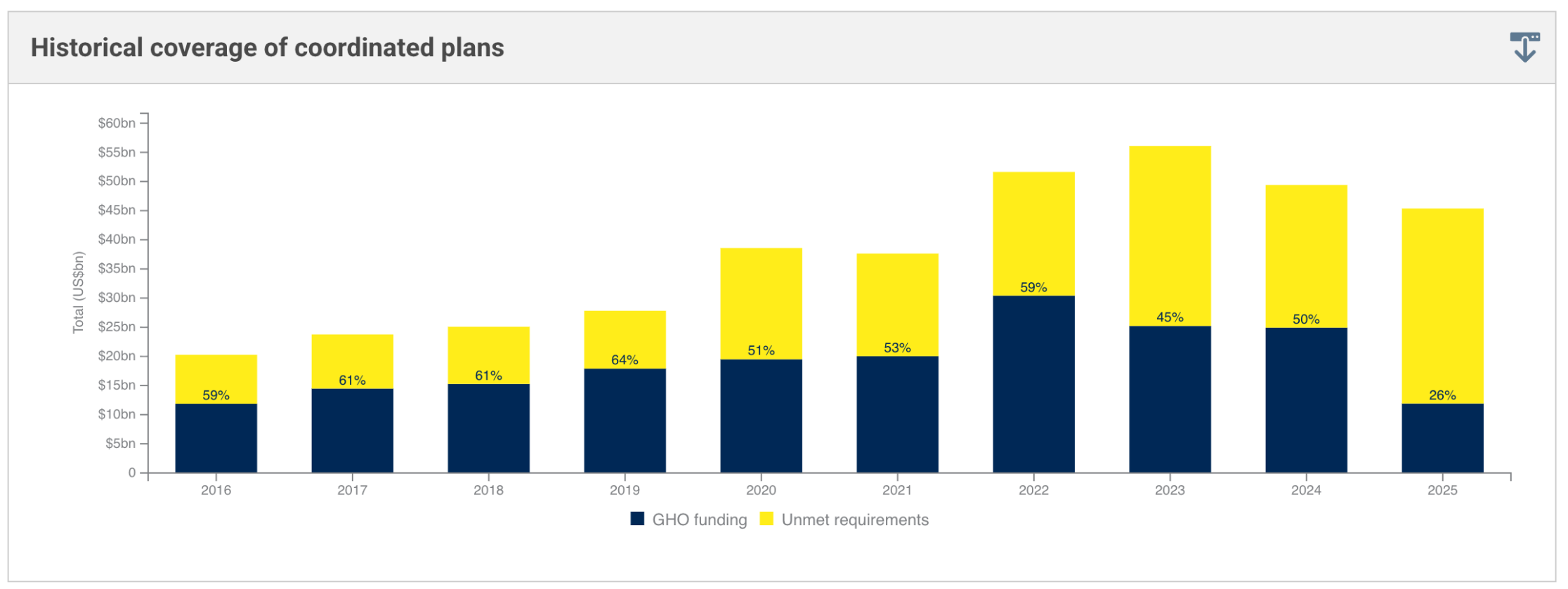
The funding collapse didn’t come out of nowhere; it came from the donors who built this architecture and are now walking away from it. The OCHA Financial Tracking Service (FTS) provides the most comprehensive overview of global humanitarian financing, and its 2022–2025 data series shows a contraction unmatched in the modern humanitarian era. In 2022, global humanitarian funding reached $43.3 billion. By 2024, it had fallen to $37 billion. And by 17 November 2025, total funding stood at $20.3 billion. That is a 53 percent decline in two years.
OCHA FTS
This scale matters. A system built around large annual flows, dozens of simultaneous major responses, and sustained multiyear commitments cannot withstand a reduction of this magnitude without profound structural consequences. The decline is not limited to one donor or one region. The largest contributors have reduced funding sharply, and no other donor bloc, whether European, Gulf, or multilateral, has increased contributions enough to offset those reductions. This creates a global environment where all agencies, not just UNHCR, face unavoidable contraction.
The FTS data also reveal shifts in donor composition. The United States, historically the system’s anchor donor, has decreased dramatically. Other major contributors, including several European governments and the European Commission, have seen their own constraints. While Gulf donors have increased contributions in some areas, these flows are often bilateral and earmarked, limiting their ability to replace broad, flexible, system-wide funding.
The result is a humanitarian economy fundamentally smaller than the one for which the current architecture was designed. Agencies that depend on predictable funding to maintain pipelines, retain staff, and operate multi-country platforms now face volatility that undermines their core functions. The contraction creates second-order effects: delayed procurement, reduced partner sub-grants, narrower activity scopes, slower reporting cycles, and increased pressure on prioritisation frameworks. This is visible in how agencies are now forced to determine which regions, sectors, or populations receive support and which do not.
In this context, UNHCR’s internal reductions reflect a broader structural trend rather than an anomaly. The FTS figures confirm that the financing model underpinning humanitarian response has fundamentally shifted. With half the funding removed from the system within two years, operational capacity cannot remain unchanged.
26% Coverage: The Fatal Signal
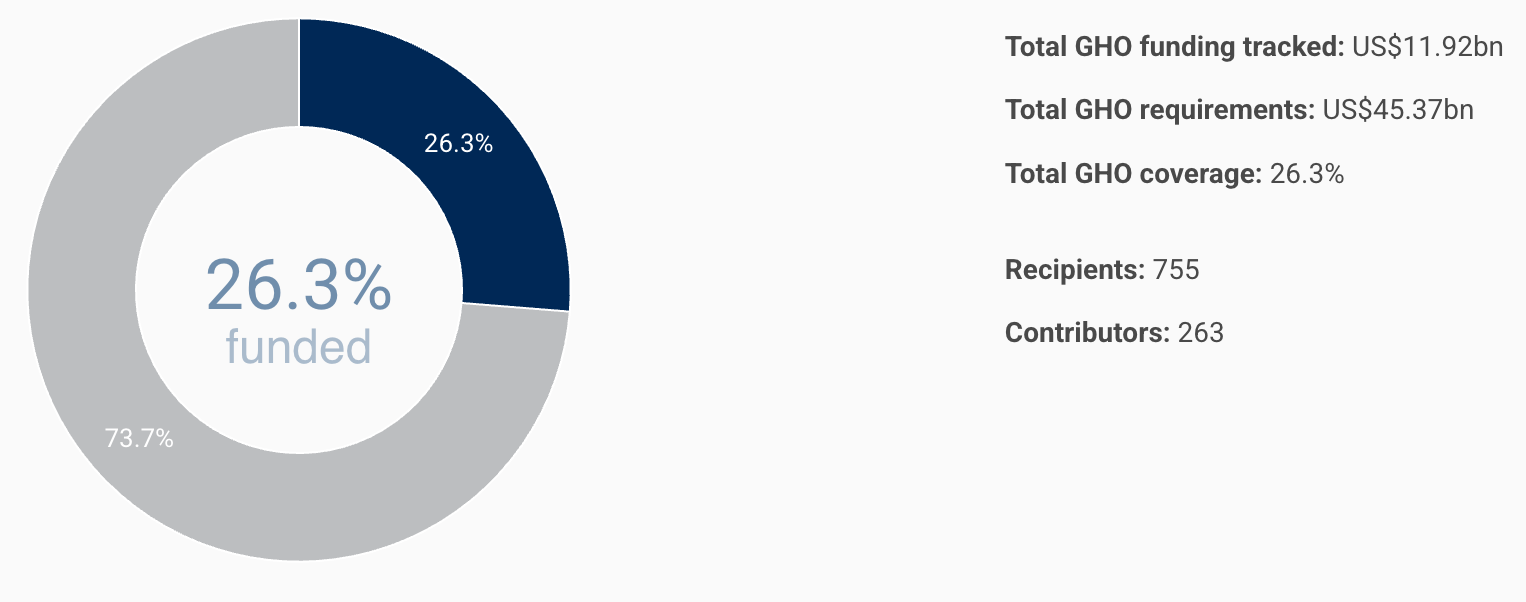
If UNHCR’s internal numbers and the FTS global totals show the financial collapse, the Global Humanitarian Overview (GHO) shows the operational reality that follows from it. The GHO currently reports that coordinated humanitarian plans in 2025 are funded at around 26 percent. This is the lowest figure on record.OCHA FTS
To understand the severity of this, it helps to consider the historical baseline. From 2017 through 2019, plan coverage consistently ranged between 61 and 64 percent. Even during the early pandemic period, when needs spiked dramatically and economies contracted, coverage hovered near 50 percent. At those levels, responses still faced shortages, but the system could generally maintain multi-sector delivery, keep supply chains moving, and preserve the integrity of large-scale operations.
A coverage rate of 26 percent is qualitatively different. At that level, the system can no longer be said to be delivering humanitarian response at scale. It instead enters a phase where it must reduce, narrow, or exit activities entirely. This affects every sector: food security, health, protection, WASH, shelter, education, and multipurpose cash. None of these can function effectively at one quarter of the resources required.
The GHO figure also aligns with what the financing patterns imply. A global decline of more than 50 percent in funding inevitably translates into reduced plan coverage. What makes 2025 distinct is that both the financing and the plan coverage figures have reached their lowest historical points simultaneously. This confirms that the constraints are not temporary or cyclical. They represent a structural shift in the capacity of the system to deliver.
Expressed simply: For every $1 required to meet humanitarian needs, the system is delivering about $0.26.
This ratio has profound operational implications. It forces agencies to make choices between geographic coverage and sector coverage, between direct delivery and system support, and between sustaining long-term displaced populations and responding to new emergencies. It also increases pressure on host governments and national NGOs, who now face greater responsibility with fewer external resources.
The 26 percent figure is the clearest numeric signal of system-level failure. It is the point at which humanitarian response cannot meet even the most basic thresholds of scale, reach, or continuity. And it is the metric that ties together UNHCR’s internal reductions and the global financing contraction documented in FTS.
The Donor Architecture Has Shattered
The Financial Tracking Service (FTS) does more than report funding totals. It exposes the deeper structural shifts shaping the humanitarian system. And in 2025, the donor landscape is not simply changing , it has fractured. The architecture that has underpinned global humanitarian action for two decades no longer resembles itself, and the implications are profound.
OCHA FTS
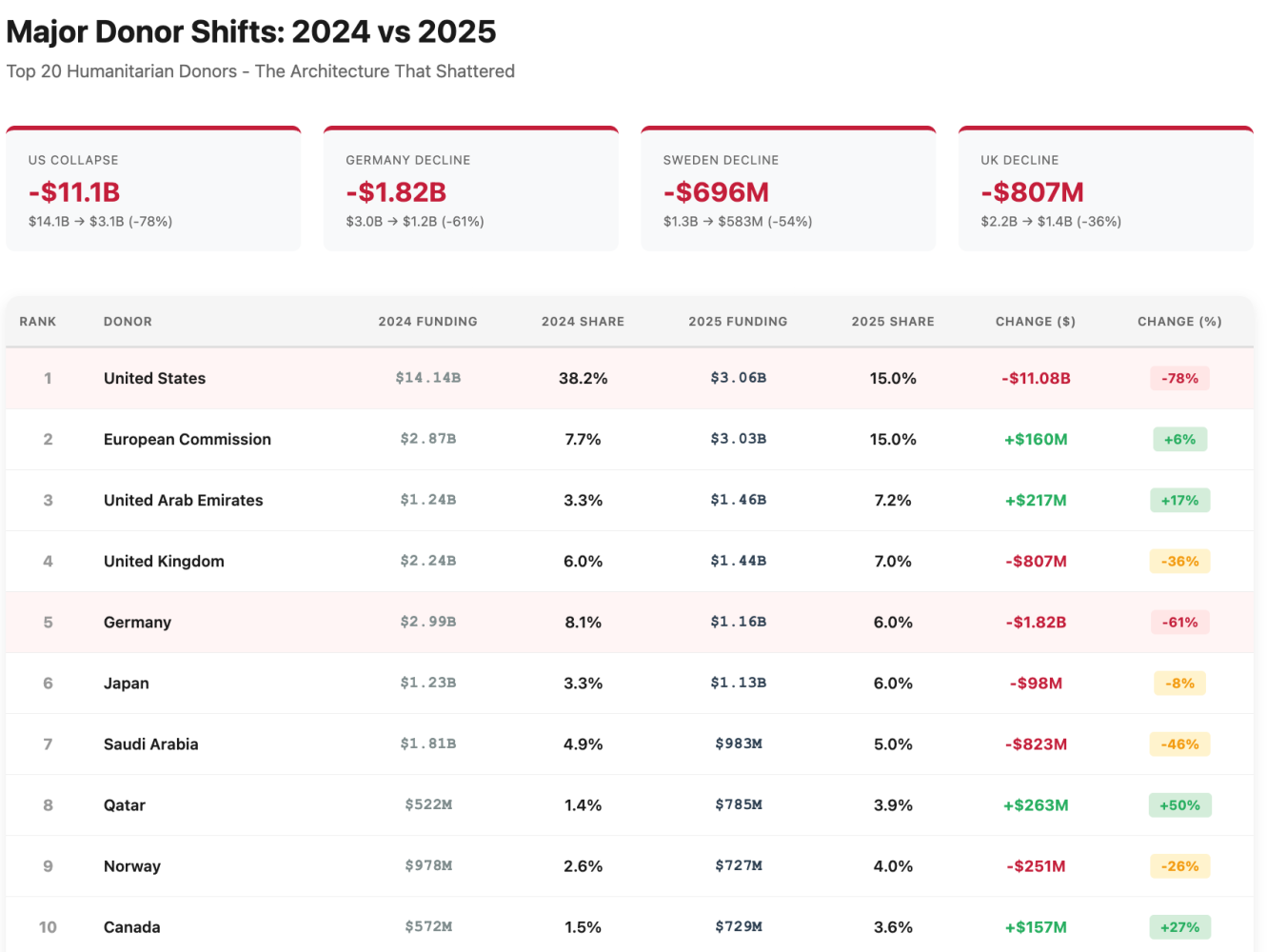
The first and most consequential shift is the collapse of the United States’ contribution. In 2024, the U.S. provided $14.1 billion, representing 38 percent of all global humanitarian funding. In 2025, it provided $3.06 billion, just 15 percent of the global total. This drop , an $11 billion reduction in a single year , is the largest contraction ever recorded for a major donor. It removed the anchor point around which the entire system has been structured. For years, planners, agencies, pooled funds, and NGOs built budgets and pipelines on the assumption that the U.S. would remain the stabilising force, even in difficult fiscal years. That assumption is now invalid.
Europe, often viewed as the secondary stabiliser, is also undergoing a fundamental shift. The European Commission modestly increased its funding in 2025 ($2.87B → $3.03B), but major European donors moved sharply in the opposite direction. Germany dropped from $2.99B to $1.16B, the United Kingdom from $2.24B to $1.43B, and Sweden from $1.28B to $0.58B. These reductions show that Europe cannot replace the scale of the U.S. withdrawal. Even combined, the EU and European member states no longer have the fiscal space to stabilise the system on their own.
The Gulf donors rose in relative prominence , the UAE, Saudi Arabia, and Qatar collectively contributed more in 2025 than ever before , but the nature of these contributions is critical. They tend to be bilateral, targeted, and often linked to specific crises or sectors. These flows are significant, but they do not function as a substitute for the broad, flexible, system-wide financing that agencies rely on to maintain global operations, staffing, and multi-country platforms.
Mid-sized donors , Canada, Norway, the Netherlands, Denmark, and others , remained consistent in proportional terms but are structurally unable to fill multi-billion-dollar gaps. Their contributions remain important, but they cannot offset a 53 percent global contraction or the loss of the single largest donor.
The axiom that emerges from the FTS data is simple: the donor architecture that held the humanitarian system together has broken apart, and no bloc or coalition is positioned to restore it to its previous scale.
Sectoral Failure: The System Retreats to the Bare Minimum
The clearest signal emerging from the 2025 Global Humanitarian Overview is this: the humanitarian system is retreating to the narrowest, ration-plus-clinic definition of "basic needs" it can still afford. Anything that gave households flexibility - especially multipurpose cash - is being cut back. The sectoral breakdowns reveal the same structural pattern across every cluster. Under deep underfunding, the system is not reorganizing around efficiency or reform. It is contracting around what it can still deliver at all.
This is not a thematic change. It is a survival posture.
But before we examine what collapses sector by sector, we need to understand something more fundamental: the funding collapse is not distributed evenly. Some crises are being abandoned almost completely.
The Geographic Reality: Who Gets Left Behind
The 2025 coordinated appeals data reveals a brutal hierarchy. When donors cut back, they don't reduce support proportionally. They retreat to a handful of priority crises and effectively abandon the rest.
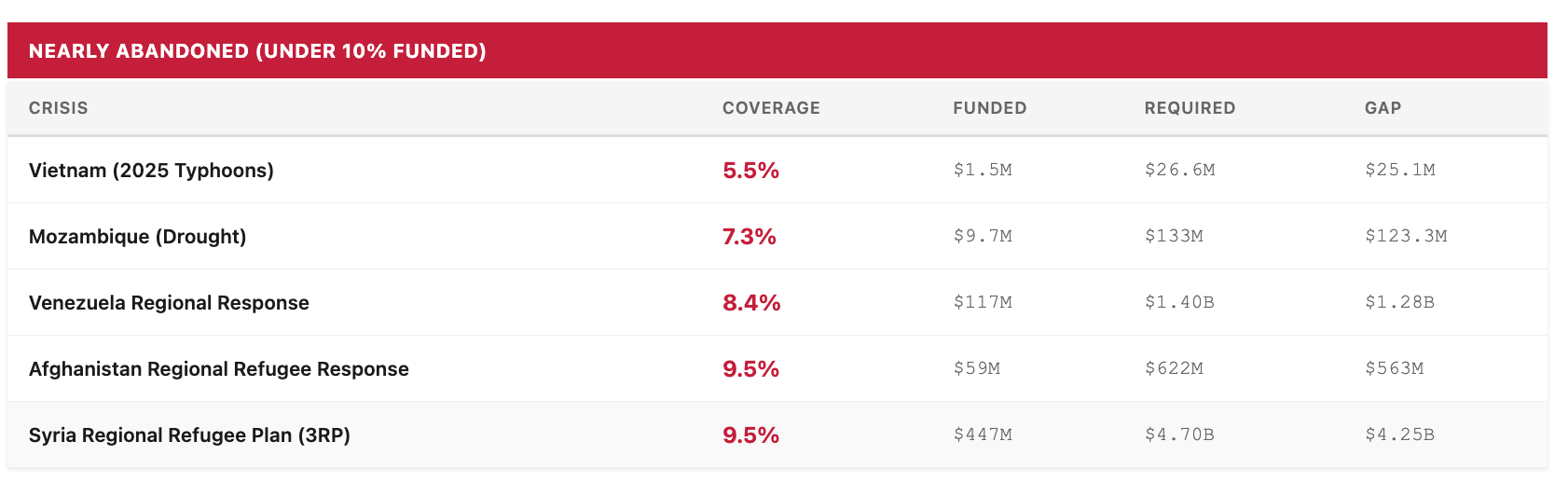
The Nearly Abandoned (under 10% funded):
OCHA FTS
Let me be clear about what these numbers mean. The Syria 3RP - covering Syrian refugees in Turkey, Lebanon, Jordan, Iraq, and Egypt - received less than one dollar for every ten dollars needed. The Venezuela regional response, covering displacement across Latin America, got 8 cents on the dollar.
The Systematically Underfunded (10-15% funded):
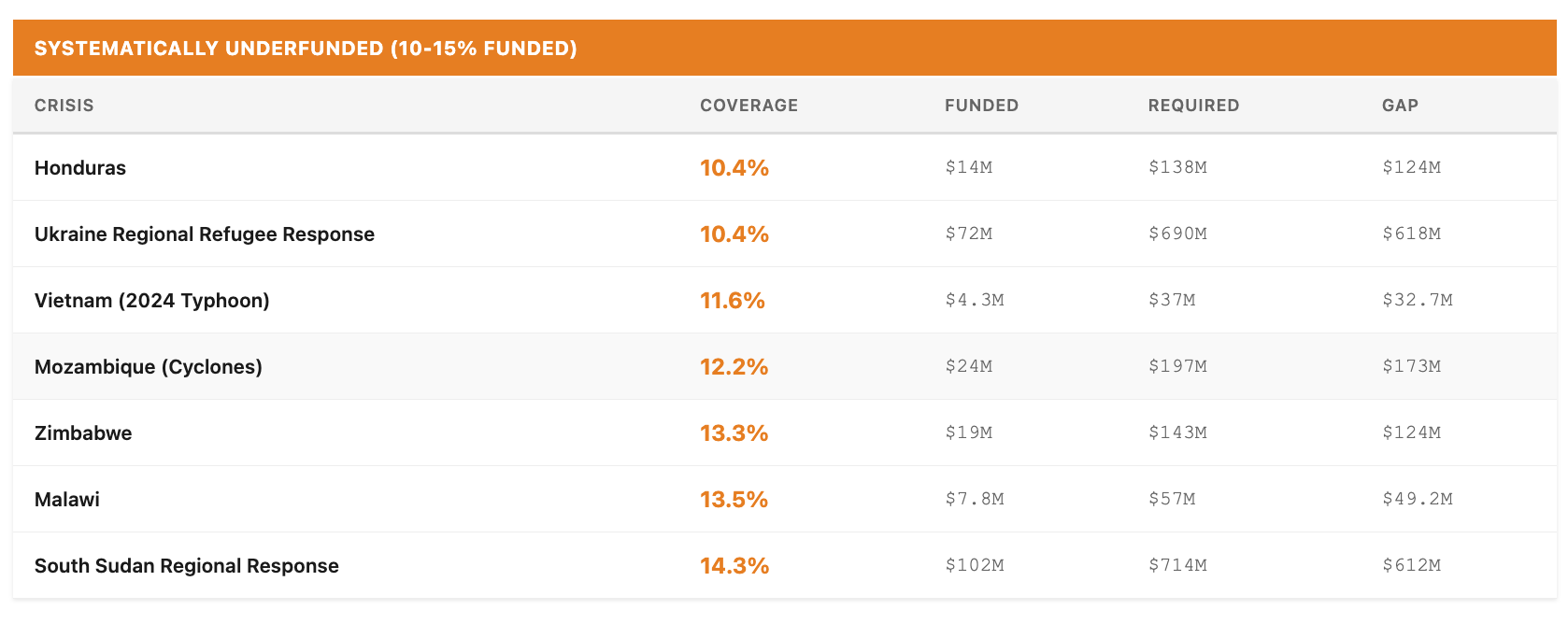
Honduras received one dollar for every ten needed. So did the Ukraine regional refugee response - not the in-country Ukraine appeal, which sits at 46%, but the response for Ukrainian refugees in neighboring countries.
The Deprioritized (15-20% funded)
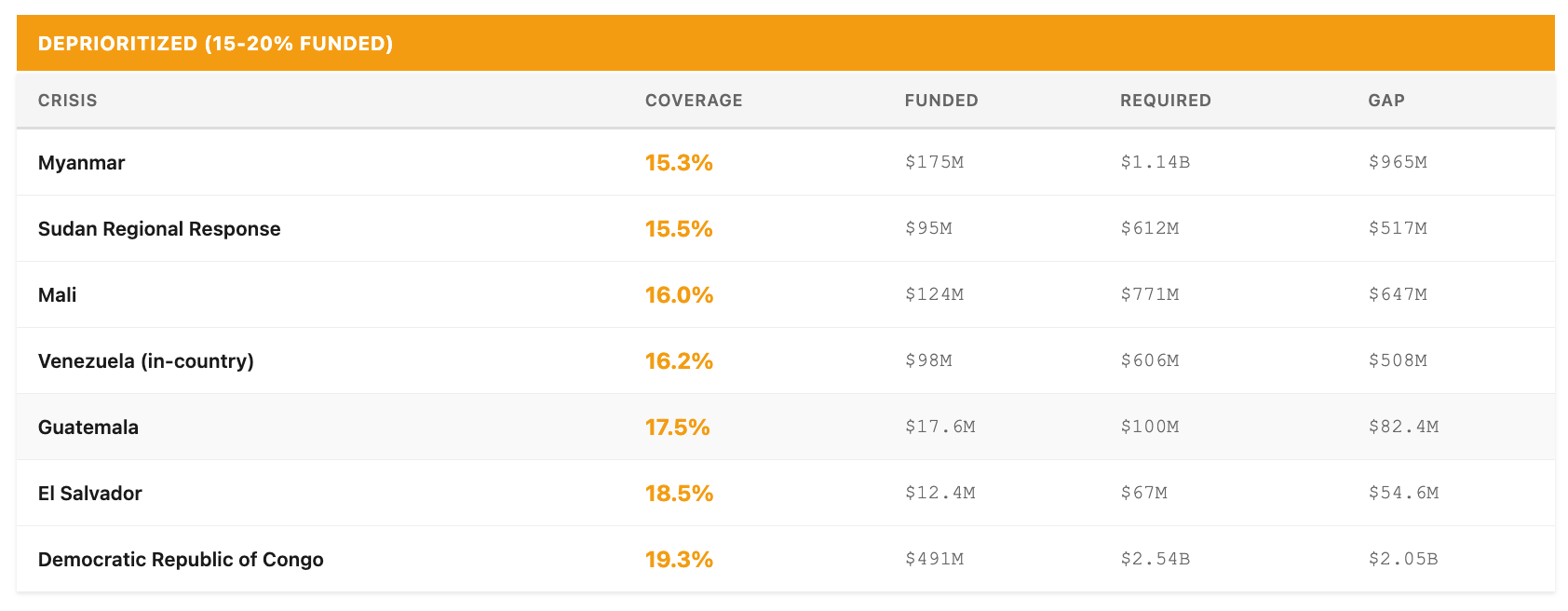
DRC - one of the world's largest humanitarian crises - sits at 19% coverage. Myanmar at 15%. These are not small-scale responses. These are major operational theaters that have been systematically defunded.
The Pattern That Emerges
When you line up the coverage rates, a clear hierarchy appears:
High-visibility, acute crises get funded - Ukraine (46%), Lebanon (58%), OPT (37%)
Long-standing crises with major donor attention maintain coverage - Afghanistan in-country (36%), South Sudan in-country (40%), Sudan in-country (32%)
Regional refugee responses collapse - Syria 3RP (9.5%), Venezuela RMRP (8.4%), Afghanistan RRP (9.5%), Ukraine RRP (10.4%)
Lower-profile crises get abandoned - Honduras (10%), Zimbabwe (13%), Malawi (13%), Vietnam (5.5%)
The system has not simply contracted proportionally. It has tiered. And if you're not in the top tier, you're operating at coverage levels that make coherent programming impossible.
What This Means for Sectoral Programming
Now we can understand what the sectoral data actually shows. When DRC sits at 19% coverage and Mali at 16%, the sectoral breakdowns we're about to examine are not just global averages. They mask an even more dire reality: in the lowest-funded contexts, sectoral coverage is far worse than the global numbers suggest.
If child protection globally sits at 14% coverage, what does it look like in Honduras at 10% overall funding? Or in the Venezuela regional response at 8.4%?
The sectoral collapse we're about to document is the system-wide average. In the bottom tier of response plans, the reality is worse.
The Sectors That Fall Below Viability
Some sectors have crossed below what anyone would consider operationally viable. The 2025 GHO data shows three clusters now functioning at coverage levels that make coherent programming nearly impossible:
Camp Coordination and Management: 11.0% funded
Funded: $46 million
Required: $415 million
Gap: $370 million
Water, Sanitation, and Hygiene: 13.7% funded
Funded: $528 million
Required: $3.86 billion
Gap: $3.33 billion
Child Protection: 14.0% funded
Funded: $186 million
Required: $1.33 billion
Gap: $1.14 billion
Camp coordination at 11% coverage means the system has effectively abandoned structured camp management. WASH at 14% means entire displacement sites are operating without adequate water or sanitation infrastructure. Child protection at 14% means the vast majority of children in humanitarian settings have no access to case management, family tracing, psychosocial support, or protection from recruitment, trafficking, or abuse.
And remember: these are global averages. In contexts like Honduras (10% overall), Mali (16%), or the Venezuela regional response (8%), these sectors are likely functionally non-existent.
These are not funding gaps. These are sector collapses.
The Retreat from Cash: The Pivot Back to Rationing
Multipurpose cash assistance once symbolized a shift toward dignified, choice-based humanitarian aid. In 2025, it sits at 20.2% coverage:
Funded: $537 million
Required: $2.66 billion
Gap: $2.13 billion
The financial conditions required for scaling cash no longer exist. Colleagues across the sector describe a pattern where the global cash architecture was already under-resourced and operating with minimal staffing. As the liquidity crisis accelerated, agencies became increasingly unable to absorb the financial exposure associated with large, unrestricted cash transfers.
Agency portfolios have shifted accordingly. With fewer grants available, and a higher share of each grant required to keep fixed operational costs functioning, cash has become harder to justify. Many teams are redesigning programs to limit multipurpose cash, shifting instead toward smaller, shorter, sector-specific transfers that can be distributed across more locations at lower risk.
In other words, portfolios are pivoting away from flexible household support and back toward tightly controlled, in-kind or sector-earmarked assistance that looks much more like the pre-cash era.
This produces the opposite of what cash was designed to achieve. Households receive less support, often in fragmented forms, and the stabilizing role of cash in local markets weakens.
The system is not scaling cash. It is exiting it - not because the modality has lost value, but because the financial model that sustained it has collapsed. What replaces it is not something better - it is a thinner, more fragmented "basic needs" package: some food, some services, but far less agency for people on the receiving end.
This is the pivot that defines 2025. And multipurpose cash is not the only casualty - it is the clearest signal of a broader retreat toward the narrowest possible interpretation of humanitarian response.
Food Security: When the Anchor Contracts
Food security sits at 25.0% coverage - the highest absolute gap in the entire GHO:
Funded: $3.49 billion
Required: $13.91 billion
Gap: $10.43 billion
Food security demonstrates what happens when the system's largest operational presence contracts. This $10.4 billion shortfall is larger than the total funding received by any agency except WFP itself. WFP's position at the top of the FTS recipient list ($4.43 billion in 2025) shows both its centrality and the scale of what's missing.
When food reductions narrow household resilience, they influence movement decisions and drive demand back into already overwhelmed protection, health, and nutrition systems. When the anchor agency contracts, every dependent function contracts with it.
Protection Under Constraint: Coverage Shrinks Across Every Sub-Sector
Protection demonstrates the most severe contraction patterns because it depends entirely on staffing and presence - monitoring, case management, documentation support, legal assistance. Underfunding directly reduces coverage.
The GHO breakdown shows the full picture:
Overall Protection: 27.6% funded ($662M / $2.40B)
Child Protection: 14.0% funded ($186M / $1.33B)
Gender-Based Violence: 18.9% funded ($210M / $1.12B)
Mine Action: 42.4% funded ($145M / $343M)
Housing, Land and Property: 3.1% funded ($1.8M / $59M)
The result is structural prioritization: fewer locations, fewer cases followed, fewer monitoring visits. Registration and documentation systems slow under reduced staffing. The cluster's ability to detect emerging risks weakens.
None of this is the result of technical strategy. This is the direct consequence of system-wide financial contraction.
Protection becomes reactive rather than preventive - a predictable outcome of a system that can no longer afford its own front-line architecture.
Health and Nutrition: Shrinking Coverage, Forced Trade-offs
Health sits at 27.1% coverage ($1.23 billion funded of $4.54 billion required). Nutrition sits at 20.1% coverage ($560 million funded of $2.78 billion required). These clusters depend on consistent supplies, outreach, and facility support - all of which decline when funding does.
Cluster leads face the same impossible choices playing out in every other sector: which districts remain supported, which services are reduced, which population groups can still be reached. The breadth of services narrows as the system prioritizes only what it can continue to supply.
This is the same survival logic shaping protection, WASH, shelter, and everything else.
The Mid-Tier Sectors: Education, Shelter, Early Recovery
Several sectors sit in the 15-20% coverage range - low enough to force severe prioritization, high enough to maintain some operational continuity:
Early Recovery: 17.4% funded ($264M / $1.52B)
Education: 20.8% funded ($550M / $2.64B)
Emergency Shelter: 15.2% funded ($516M / $3.40B)
These numbers tell you exactly what the system has decided it cannot sustain: investment in transitions (early recovery at 17%), education programming beyond the most basic enrollment support, and adequate shelter beyond emergency distributions.
The system is choosing immediate survival functions over anything that builds toward a medium-term exit from crisis.
Coordination: Better Funded, Still Failing
Coordination sits at 32.4% coverage ($257 million funded of $795 million required). This makes it one of the better-funded clusters in the GHO - which tells you everything about how dire the rest of the system has become.
But 32% is still a two-thirds funding gap. And coordination is not a sector you can run at one-third capacity and expect the rest of the system to function. Inter-cluster prioritization increasingly replaces full-system coherence. Information products thin out. Convening power weakens - exactly when prioritization decisions require more analytical clarity, not less.
The system must now prioritize without the full strength of the tools that make prioritization possible.
What This Means (My Take / Connecting the Dots)
I've been tracking humanitarian financing long enough to know the difference between a bad year and a structural break. This is a structural break.
The numbers I've just walked you through - the 26% average coverage, the geographic tiering, the sectoral collapse - don't describe underfunding. They describe non-delivery. And we need to be honest about what that means, not just for agencies, but for the people those agencies exist to serve.
This Isn't Underfunding - It's Non-Delivery
Here's the truth: no humanitarian cluster can operate coherently at 25% coverage. Not food security. Not health. Not protection. Not WASH. And certainly not child protection at 14% or camp coordination at 11%.
When a sector falls below one-third of requirements, you cross a threshold. Programming stops being strategic and becomes reactive. You're no longer implementing a plan - you're triaging who gets left out. Coverage maps shrink. Monitoring weakens. Follow-up disappears. The system isn't delivering reduced services. It's delivering intermittent presence.
Colleagues have reported reduced clinic hours, stretched distribution cycles, and monitoring gaps, the predictable operational patterns that emerge under 26 percent coverage. This is what 26% coverage produces. Not a leaner humanitarian response. A broken one.
And the data makes this undeniable. When you look at the sectoral breakdowns, when you see child protection at 14% and WASH at 14% and multipurpose cash at 20%, you're not looking at agencies that need to "do more with less." You're looking at functions that have fallen below the threshold of viability.
The system is no longer underfunded. It is non-operational in significant parts of its mandate.
Agencies Are Shrinking Into Existential Cores
Now let's talk about what happens when the money runs out.
Agencies don't disappear overnight. They contract. And when they contract under this kind of pressure, they retreat to what I call their "existential core" - the absolute minimum they need to justify continued operations.
For WFP, that means food distributions, even if rations are cut and cycles are extended. For UNICEF, that means vaccines and basic nutrition supplies, even if health promotion and community engagement disappear. For UNHCR, that means registration and basic protection monitoring, even if everything beyond documentation support gets scaled back or eliminated.
This isn't agencies being strategic. This is agencies trying to survive.
And here's what that produces: a humanitarian system that looks increasingly like it did 20 years ago. Rations. Clinics. Distributions. The things you can deliver with trucks and supplies and minimal staffing. Everything that required sustained presence, relationship-building, community engagement, or longer-term investment - that's what goes first.
Look at what's disappearing:
Multipurpose cash (20% coverage) - because it requires liquidity, financial infrastructure, and trust
Early recovery (17% coverage) - because it requires multi-year commitments
Child protection (14% coverage) - because it requires staffing, case management, follow-up
Education (21% coverage) - because it requires sustained programming beyond emergency enrollment
WASH (14% coverage) - because maintaining infrastructure costs more than emergency water trucking
The system is not optimizing. It is reverting. And what it's reverting to is the most basic, transactional, in-kind model of humanitarian assistance that existed before the sector tried to become something better.
This is the real story of the 2025 data. Agencies are not finding efficiencies. They are abandoning functions.
The Geographic Tiering Reveals Donor Priorities, Not Needs
Let's be honest about what the geographic data shows.
When Ukraine maintains 46% coverage and Honduras gets 10%, when Lebanon gets 58% and Vietnam gets 5.5%, when the Syria in-country response gets funded while the Syria regional refugee plan sits at 9.5% - that's not random. That's donor choice.
Donors are making explicit decisions about which crises matter and which don't. And the pattern is clear:
High-visibility, politically relevant crises get funded. Ukraine, Lebanon, OPT - these are contexts where donors have clear political interests and where media attention remains high.
Long-standing crises with established donor relationships maintain some coverage. Afghanistan, South Sudan, Sudan - these aren't funded well, but they're funded enough to keep core operations running.
Everything else gets abandoned. Regional refugee responses. Lower-profile displacement crises. Contexts without strong bilateral relationships or high media visibility. These fall to coverage levels where coherent programming is impossible.
This is triage. And it's triage based on donor interest, not humanitarian need.
I'm not naive enough to think humanitarian funding was ever perfectly needs-based. But what we're seeing now is more explicit than anything I've tracked before. The humanitarian system is stratifying into tiers, and if you're not in the top tier, you're being left to operate at coverage levels that make failure inevitable.
The system isn't collapsing evenly. It's collapsing selectively. And the people in Honduras, Vietnam, Zimbabwe, Malawi, and the bottom tier of response plans are bearing the cost of that selectivity.
This Is What Institutional Failure Looks Like
I want to be very clear about something: the agencies implementing these programs are not failing because they lack competence or commitment. The operational staff I know - the cluster coordinators, the program managers, the field teams trying to stretch every dollar - are doing everything they can with what they have.
This is institutional failure at a different level. This is the failure of the donor architecture that funds humanitarian response. This is the failure of political systems that treat humanitarian assistance as discretionary rather than obligatory. This is the failure of coordination mechanisms that cannot compel action when governments decide other priorities matter more.
And here's what that means in practice:
When UNHCR cuts its workforce by 30% and reduces its presence in 185 locations, that's not UNHCR failing. That's donors pulling back and UNHCR trying to manage an impossible contraction.
When WFP faces a $10.4 billion food security gap and has to cut rations and extend distribution cycles, that's not WFP failing. That's the largest humanitarian agency in the world being forced to operate at one-quarter of requirements.
When child protection sits at 14% coverage and case management systems collapse, that's not agencies failing to prioritize children. That's a system that can no longer afford to protect children at anything approaching adequate scale.
The 2025 data doesn't show agencies making bad choices. It shows agencies with no good choices left.
The Return to Rationing
Here's what all of this adds up to:
The humanitarian system is returning to a model that looks much more like emergency relief in the 1990s than the more sophisticated, dignity-focused, community-engaged approach the sector spent 20 years trying to build.
Multipurpose cash - the clearest expression of household agency and choice - is being cut back. Protection programming - which depends on sustained presence and relationship-building - is being reduced to minimal monitoring. Education, early recovery, and anything that looked like investment in medium-term stability is being deprioritized.
What remains is food distributions, basic health services, and emergency shelter support. The core functions. The things you can deliver transactionally.
This is not because agencies have decided this is the right approach. This is because this is what you can still afford when coverage drops to 26%.
And let's be clear about what that means for the people on the receiving end: less choice, less dignity, less agency, and less hope that their situation will improve anytime soon.
The system is not adapting to constraints. It is regressing under pressure. And that regression is taking us back to a model of humanitarian assistance that we spent decades trying to move beyond.
What This Tells Us About the Next Phase
If 2025 shows us anything, it's that we've entered a new phase of humanitarian crisis response - one where the international community is no longer willing or able to fund the system at anywhere near the level required.
The question now is: what comes next?
Does the system continue to contract until it reaches some new, lower equilibrium? Do certain contexts get abandoned entirely while others maintain functional coverage? Do agencies find ways to dramatically reduce costs and still deliver meaningful assistance? Or does something break - a major crisis that gets no response, a context where agencies simply withdraw because they can't operate at 10% coverage?
I don't know the answer. But I know we're heading toward it faster than most people realize.
The 2025 data is not describing a temporary funding shock. It is describing the beginning of a systemic reordering. And if donors continue on this trajectory, the humanitarian system that emerges on the other side will look fundamentally different from the one we've known.
Smaller. More selective. More transactional. Less invested in anything beyond immediate survival.
That's the trajectory we're on. And the numbers make it impossible to deny.
What I'm Watching
As we move into 2026, I'm tracking three things:
First: Whether any of the bottom-tier contexts simply collapse. When you're operating at 5-10% coverage, you're one shock away from complete loss of operational capacity. If that happens - if we see a context where agencies withdraw entirely because they can't function - that will be the clearest signal yet that we've crossed into a new phase.
Second: Whether multipurpose cash stabilizes or continues to decline. Cash at 20% coverage is already a retreat. If it drops further in 2026, that will confirm that the sector is locking in a return to in-kind, ration-based programming as the new normal.
Third: Whether donors acknowledge what's happening or continue to pretend this is manageable. The rhetoric from capitals still talks about "efficiency" and "prioritization" as if this is a technical challenge. It's not. This is abandonment. And until donors are willing to name it as such, nothing will change.
The data has told us everything we need to know. The system is in retreat. Coverage is collapsing. Some contexts are being abandoned. And the humanitarian model we've spent 20 years building is being dismantled by a funding crisis that shows no sign of reversing.
The question is whether anyone with the power to change this is willing to face what the numbers are showing.
Conclusion: What Replaces the System We Built?
On November 17, 2025, High Commissioner Filippo Grandi delivered his final briefing to the UN General Assembly's Third Committee. He presented the numbers I've just walked you through: the 25% budget cut, the 30% workforce reduction, the contraction of UNHCR's presence in 185 locations. He described a funding crisis that is "as bad" as anything the humanitarian sector has faced "in modern times."
And then he said something that deserves attention: "Some are saying that these reductions were overdue, that they are an opportunity for UNHCR to become more efficient, to return to our quote-unquote core mandate... I couldn't disagree more. These cuts will make it more difficult to save lives, to deliver on our mandate."
That statement landed in a room full of member states, many of whom had just reduced their contributions. It landed in the middle of two major reform processes - the UN80 initiative and the humanitarian reset - both of which are being framed as opportunities to build a "more efficient, transparent, and sustainable" humanitarian system.
Here's what I want to know: What system are we building?
Because the data I've presented in this analysis doesn't show reform. It shows retreat. It doesn't show optimization. It shows abandonment. And if we're serious about UN80 and the humanitarian reset, we need to be honest about what's actually happening on the ground while we talk about efficiency in Geneva and New York.
The Timing Matters
UNHCR turns 75 this year. The organization was created in 1950 to address displacement in post-war Europe. It was meant to be temporary. Instead, it became the anchor of the global refugee protection system - a system that now covers 117 million people worldwide.
The Global Refugee Forum progress review happens in December 2025. UN80 and the humanitarian reset are both underway. These are all meant to be moments of renewal, of strategic repositioning, of collective recommitment to the humanitarian architecture we've built together over decades.
Instead, we're watching that architecture contract in real time.
UNHCR's 75th anniversary coincides with its most severe funding crisis. The humanitarian reset is happening while the humanitarian system operates at 26% of requirements. UN80 is meant to strengthen multilateralism while donors pull back from multilateral humanitarian funding.
The disconnect is staggering.
What We're Actually Resetting To
Let me be direct about what the 2025 data shows:
We are not resetting to a more efficient version of the system we had. We are resetting to a fundamentally different system - one that looks much more like humanitarian response in the 1990s than anything we've built since.
What's being kept:
Food distributions (even if rations are cut)
Basic health services (even if coverage shrinks)
Emergency shelter (even if it's only distributions, not infrastructure)
Minimal protection monitoring (even if follow-up disappears)
What's being cut:
Multipurpose cash and household agency
Sustained protection presence and case management
Education beyond emergency enrollment
Early recovery and investment in transitions
Community engagement and participation
Anything that requires multi-year commitments
This is not efficiency. This is regression.
And if the humanitarian reset and UN80 lock in this model as the new normal - if we start treating 26% coverage and ration-based programming as "sustainable" simply because it's what we can still afford - then we will have fundamentally abandoned the principles we spent 20 years trying to embed in humanitarian response.
Dignity. Agency. Community-driven programming. Protection as more than paperwork. Humanitarian assistance as something that helps people rebuild, not just survive.
All of that requires resources. And in 2025, those resources are gone.
The Question We're Not Asking
Here's what almost no one in the reform discussions is willing to say out loud:
If the current funding model cannot sustain the humanitarian system we built, what system can it sustain?
Because that's the real question. The 2025 data has given us the answer: it can sustain food distributions, minimal health services, and emergency shelter support for a subset of crises. That's it. Everything else is now optional, and in most contexts, it's being cut.
So when we talk about the humanitarian reset, when we talk about UN80, when we talk about UNHCR's 75th anniversary and the progress review of the Global Refugee Forum - we need to be asking:
Are we reforming the system we want to keep? Or are we managing the decline of a system we can no longer afford?
Because the data suggests it's the latter. And if that's true, we should at least be honest about it.
What I Need From You
I don't write these analyses to generate discussion questions or policy recommendations that no one will implement. I write them because I think field evidence matters, and because I think the people making decisions need to know what's actually happening on the ground.
So here's what I need:
If you're working in one of the contexts I've flagged - Honduras at 10% coverage, Vietnam at 5.5%, the Syria regional response at 9.5%, Zimbabwe, Malawi, DRC at 19% - tell me what that looks like.
What programming have you cut? What populations are you no longer reaching? What services have you reduced from weekly to monthly, or from monthly to quarterly, or eliminated entirely?
What does 26% coverage actually look like when you're trying to run a protection program, or a nutrition program, or a WASH response, or a child protection system?
And if you're watching multipurpose cash get cut back in your context - if you're seeing portfolios pivot back toward in-kind distributions and sector-specific transfers - tell me what that transition looks like. Tell me what it means for the households you're supposed to be serving.
If you're in coordination roles - cluster leads, OCHA staff, HC offices - tell me how you're making prioritization decisions when you're operating at one-third of requirements or less.
What gets prioritized? What gets cut? How are you managing stakeholder expectations when everyone knows there isn't enough to go around? And what does coordination look like when you don't have the resources to coordinate effectively?
And if you're in agency headquarters or donor capitals, and you're part of the UN80 or humanitarian reset discussions - tell me how you're reconciling the reform rhetoric with the operational reality.
Because from where I'm sitting, the gap between what's being discussed in Geneva and New York and what's happening in Tegucigalpa and Harare and Sana'a is wider than I've ever seen it.
The Briefing I Want to Give
Here's what I'd say if I was briefing donors right now:
You have spent 20 years building a humanitarian system that tried to be something better than emergency relief. You invested in cash programming, in protection, in community engagement, in education, in early recovery. You pushed agencies to be more accountable, more dignified, more focused on what people actually need rather than what's easiest to deliver.
And now you're pulling back the funding that made any of that possible.
So you have a choice.
You can keep pretending this is about efficiency and prioritization and reform. You can keep framing the cuts as opportunities for agencies to get leaner and more focused. You can keep talking about UN80 and the humanitarian reset as if they're going to produce a better system.
Or you can be honest.
You can acknowledge that at 26% coverage, the system you built cannot function. You can acknowledge that agencies are not finding efficiencies - they are cutting programs, reducing coverage, and abandoning functions. You can acknowledge that some contexts are being left behind entirely, and that the geographic tiering we're seeing is not based on need but on donor political priorities.
And if you're honest about that, then maybe we can have a real conversation about what comes next.
But we cannot have that conversation while pretending that everything is fine, that this is all just part of a necessary reform process, and that the system will somehow adapt.
The system is not adapting. It is collapsing. And the 2025 data makes that undeniable.
The Evidence Matters
I'll close with this.
I've been tracking this sector long enough to know that analysis only matters if it connects to reality. The numbers I've presented here - the 26% coverage, the sectoral collapse, the geographic abandonment - only mean something if they match what people are actually experiencing in the field.
So if you're out there - if you're watching this unfold in real time - I need to hear from you.
Not because I think one more analysis is going to change donor behavior. But because I think we owe it to each other to document what's actually happening, to name it clearly, and to refuse to let the reform rhetoric obscure the operational reality.
The humanitarian system is in retreat. Coverage is collapsing. Some contexts are being abandoned. The model we spent 20 years building is being dismantled by a funding crisis that shows no sign of reversing. If this is what collapse looks like at 26 percent coverage, what happens at 20?
That's what the data shows.
Now tell me what you're seeing.
What are you witnessing in your context? What's being cut? What's being kept? And what does the "humanitarian reset" actually look like from where you're standing?
Share what you're seeing. We need the field evidence, not the reform rhetoric.
#HumanitarianCrisis #UNHCR #OCHA #AidFunding #Refugees #InternationalDevelopment #DonorPolitics #CashAssistance #SystemCollapse #UN80 #HumanitarianReset #GlobalCrisis
Enjoyed this article?
This post is from Aid and Dev Dispatches, a LinkedIn newsletter with expert analysis on humanitarian reform, AI adoption, crisis economics, and the politics of aid. Join 9,000+ subscribers.