OCHA Data Confirms Scale of US Aid Cuts: 79 Million Affected, Local NGOs Hit Hardest
Executive Summary
The latest UN OCHA survey confirms the devastating, systemic impact of recent US foreign assistance terminations across the humanitarian sector. Key findings reveal:
Massive Human Cost: An estimated 79 million people previously targeted for assistance by survey respondents are no longer being reached due to program cuts.
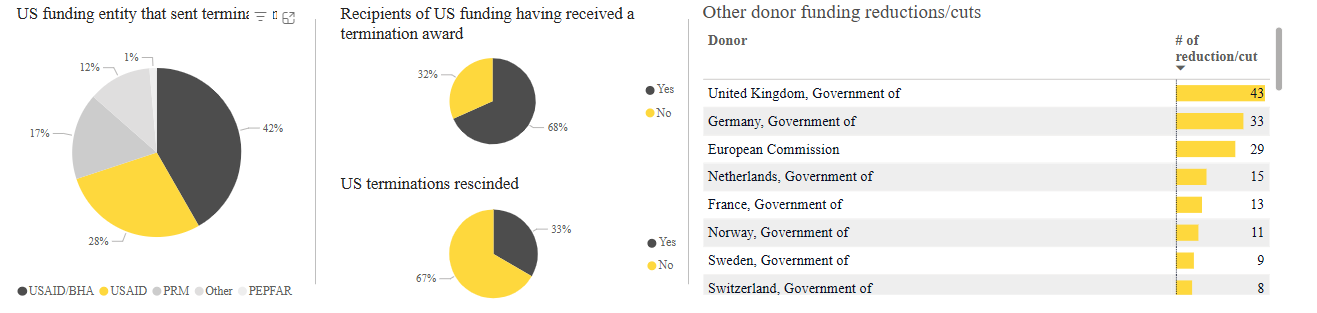
Local Capacity Decimated: National NGOs bear the heaviest burden, with 75% reporting US funding terminations and only 30% seeing those rescinded—a significant blow to localization efforts.
Coordination Architecture Crumbling: Projected losses of over 197 dedicated cluster coordination and information management staff by June 2025 severely hamper the collective ability to respond effectively.
Quantifying the Crisis Beyond Anecdotal Evidence
The past few months have brought unprecedented upheaval to the U.S. foreign assistance landscape. Following widespread funding freezes, the subsequent wave of program terminations has sent shockwaves through the humanitarian and development community. While initial reports highlighted the chaos, the UN Office for the Coordination of Humanitarian Affairs (OCHA), collaborating with IOM, UNHCR, and ICVA, has now provided critical data quantifying the impact through its second global survey (conducted March 10-21, 2025).
Drawing on nearly 1,000 responses across 68 operations, this survey offers the most comprehensive picture yet of the operational realities and systemic shocks unfolding globally. For leaders in our sector – Program/Project Managers, Founders, CEOs, Technical Advisors – this data provides an essential, evidence-based analysis of the human cost, the disproportionate impact on local partners and protection efforts, the operational collapse, the erosion of coordination, and the urgent need for strategic adaptation.
The Human Cost: 79 Million Affected
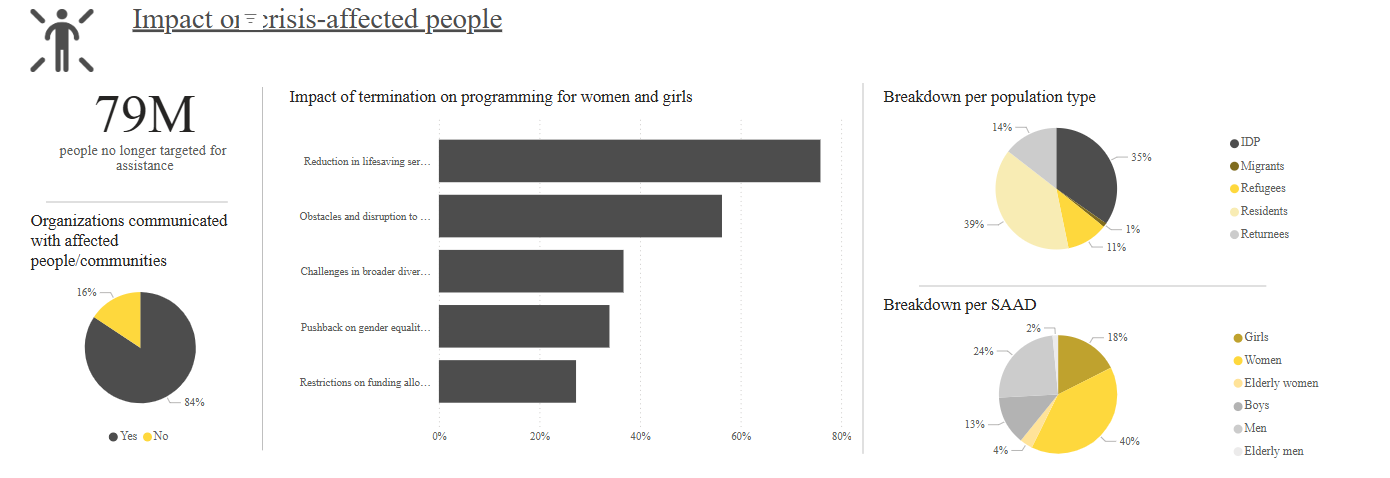
The most striking headline figure is the 79 million people previously targeted for assistance who survey respondents report they can no longer reach due to US funding terminations. This isn't an abstract projection; it represents individuals in crisis situations now deprived of planned shelter, protection, healthcare, clean water, and food.
Further illustrating the service delivery collapse among organizations reporting US terminations:
71% reported a reduction in services or assistance.
44% reported completely ceasing previously US-funded operations.
This confirms a massive, rapid contraction of the global humanitarian safety net.
The Undermining of Local Humanitarian Capacity
The OCHA data validates earlier analyses: national and local organizations are bearing the disproportionate brunt of these funding shifts.
National NGOs (NNGOs): 75% reported termination notices (vs. 68% average). Critically, only 30% saw funding reinstated (vs. 33% overall), indicating a more permanent defunding compared to INGOs.
Women-Led & Refugee-Led Organizations: An alarming 80% reported receiving termination notifications, directly undermining stated international commitments to support these vital groups.
Local Partnerships Suspended: Reflecting the financial strain, 41% of respondents have been forced to suspend partnerships with local actors.
This systematic impact represents a severe setback for the localization agenda, eroding local expertise, trust, and sustainability precisely when it's needed most.
Operational Collapse: Staffing, Coverage, and Footprint
The operational capacity of the sector has been significantly damaged:
Staffing: At least 12,000 humanitarian staff contracts have been terminated, representing a major loss of skilled professionals and institutional memory.
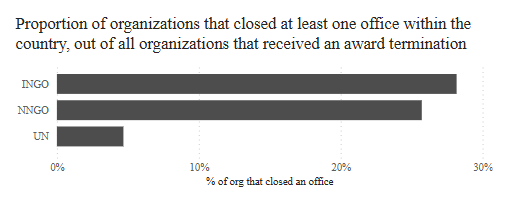
Office Closures: 22 organizations reported completely shuttering operations in affected countries. Furthermore, 28% of INGOs and 26% of NNGOs receiving US terminations were forced to close at least one office.
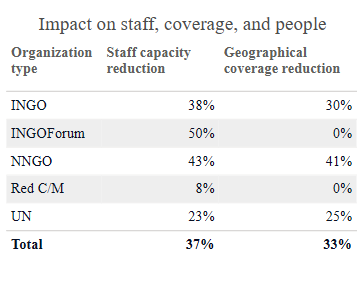
Reduced Coverage: Organizations reported an average 33% reduction in geographic coverage (41% for NNGOs specifically), creating humanitarian deserts in vulnerable regions.
This operational contraction drastically limits the reach and effectiveness of remaining humanitarian efforts.
Coordination Architecture Crumbling
Effective humanitarian response relies on robust coordination. The OCHA survey reveals this vital architecture is under severe threat:
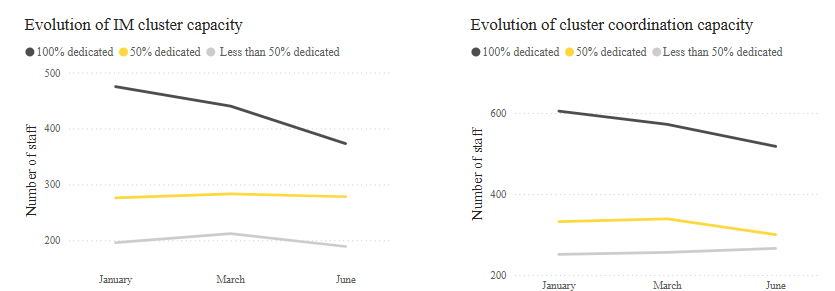
Cluster Capacity Loss: Projections based on 24 operations indicate a net loss of 96 dedicated cluster coordination staff and 101 dedicated information management staff by June 2025.
NGO Forum Weakening: INGO Forums reported a staggering 50% reduction in staff capacity, while NNGO Forums saw a 43% reduction.
Reduced Engagement: 35% of respondents reduced their own coordination capacity, and 25% reduced participation in coordination mechanisms.
For managers and directors, this degradation of coordination means increased risks of duplication, inefficiency, and critical gaps in aid delivery – undermining the effectiveness donors demand.
Protection Services Heavily Impacted
Protection programming, often complex and vital for the most vulnerable, appears significantly affected:
Reduced Services for Women & Girls: 76% of organizations with US terminations reported reducing life-saving assistance specifically for women and girls.
GBV Funding Cut: Gender-Based Violence services faced the second-highest reported monetary cut ($61 million).
High Sector Termination Rates: Critical protection sub-sectors reported high termination rates for US funding: Housing, Land and Property (81%), Child Protection (75%), and GBV (73%).
Gender Equality Pushback: Notably, 34% of partners reported explicit pushback on gender equality programming during this period.
This pattern raises serious concerns about the de-prioritization of protection principles within the shifting funding landscape.
Analysis: Deeper Implications of the Data
The OCHA data points to consequences beyond immediate service cuts:
Localization in Reverse: The disproportionate, permanent cuts facing NNGOs, WLOs, and RLOs actively reverse progress on localization commitments, weakening the sector's long-term sustainability and effectiveness.
The Vulnerability of Protection: The heavy impact on protection suggests these programs may be viewed as less essential or face ideological headwinds, challenging core humanitarian principles and commitments.
Coordination Collapse Undermines Efficiency: The breakdown in coordination directly impacts aid effectiveness and efficient use of resources – key concerns for all donors.
A Broader Donor Retreat: The confirmation of significant cuts from other major donors (UK, Germany, EC reported by 29% of respondents, rising to 45% in refugee responses) signals a wider, worrying contraction in global ODA, demanding sector-wide strategic shifts.
Strategic Adaptation for a Post-US Aid World
With 67% of US terminations reported as not rescinded by late March, relying on hope for funding restoration is no longer viable. Humanitarian leaders must pivot to strategic adaptation:
Implement Strategic Prioritization: Focus exclusively on core life-saving interventions (emergency food/nutrition, essential health, critical WASH, immediate protection). Develop transparent, defensible criteria for these difficult choices, potentially scaling back less critical programming.
Recalibrate Funding Strategies: Diversify funding realistically. Target genuinely new sources (specific foundations, non-traditional government donors, innovative/outcome-based finance) rather than relying solely on traditional ODA donors facing their own cuts.
Collaborate Radically: The fragmented ecosystem is inefficient. Actively seek opportunities to share resources, operational platforms, technical expertise, and consider strategic mergers or consortia to preserve life-saving capacity.
Conduct Rigorous Financial Reviews: Eliminate all non-essential administrative and operational overhead. Maximize the percentage of every dollar reaching beneficiaries.
Invest in Lean Digital Coordination: Leverage shared digital platforms, data standards, and remote coordination tools to compensate for reduced dedicated coordination staff and maintain operational efficiency.
Urgently Clarify & Defend Lifesaving MPCA: The sector must coalesce around an operational definition of Multipurpose Cash Assistance (MPCA) unequivocally tied to immediate, measurable survival outcomes (preventing starvation, acute health needs, emergency shelter, mitigating immediate protection risks). Advocate collectively with donors, emphasizing MPCA's efficiency for survival needs, and rigorously document outcomes linked to lifesaving objectives to withstand scrutiny in a restricted funding environment.
Conclusion: Facing the New Reality
The OCHA survey provides stark, data-driven evidence of a fundamental reshaping of the humanitarian landscape. The 79 million people affected underscore the human cost of this rapid contraction. For humanitarian and development leaders, acknowledging the likely permanence of these shifts and embracing radical adaptation is now essential. Strategic prioritization, innovative coordination, realistic funding strategies, and a relentless focus on core life-saving activities are imperatives for organizational survival and continued impact.
Discussion Questions
Beyond the survey data, what specific operational impacts (especially on coordination and local partnerships) are you seeing most acutely in your programs or region?
How is your organization adapting its strategic priorities and operational model to navigate this reduced funding environment while upholding core principles?
What innovative approaches or collaborations are proving effective in maintaining critical services despite resource constraints?
Hashtags:
#HumanitarianCollapse #FundingCrisis #OCHASurvey #USAid #GlobalDevelopment #NGO #LocalizationBetrayal #AidEffectiveness #HumanitarianCoordination #ProtectionDefunded #PostUSAid
Enjoyed this article?
This post is from Aid and Dev Dispatches, a LinkedIn newsletter with expert analysis on humanitarian reform, AI adoption, crisis economics, and the politics of aid. Join 9,000+ subscribers.