When the Canary Coughs: How US Tariffs and Aid Cuts Fuel a Global Storm
In Brief: Key Findings
Dual Shock Paralyzes Global Systems: Aggressive new US tariffs (on top of existing ones, targeting subsidized Chinese green tech) froze global trade in early April 2025, evidenced by a ~50% plunge in ocean freight bookings (FreightWaves, 2025; Vizion API, 2025). This coincides with the deliberate dismantling of US foreign aid, with ~10,000 USAID/State Dept. awards terminated (Devex, 2025b) and drastic budget cuts proposed (Politico, 2025).
Trade & Logistics in Turmoil: The "tariff shockwave" led to unprecedented blank sailings (canceled ship departures) (12% cancellation rate on key routes), disrupting supply chains (Drewry, 2025; World Cargo News, 2025) and prompting the WTO to slash its 2025 trade growth forecast to negative territory (-0.2%) (Reuters, 2025a; AP News, 2025).
Humanitarian Crisis Deepens: Simultaneous aid cuts sever lifelines. In Uganda, HIV clinics ration life-saving ARVs (Devex, 2025a); across Africa, thousands of health workers lose jobs (Devex, 2025c; The Lancet, 2025; Wired, 2025); and essential programs face termination globally (The Guardian, 2025; NPR, 2025).
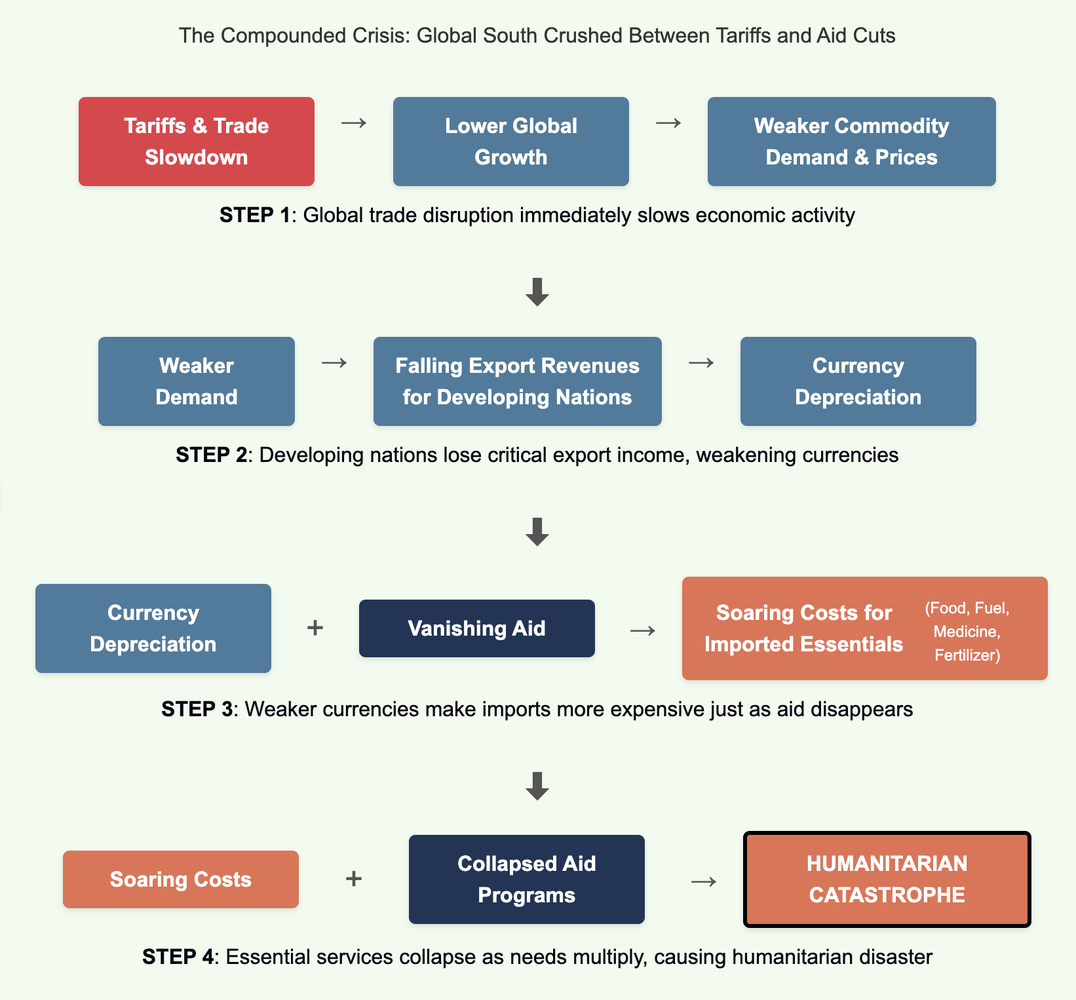
Global South Hit Hardest: A vicious cascade—tariffs slow growth, reducing export revenues, weakening currencies, and raising import costs (food, fuel, medicine)—compounds the suffering caused by direct aid withdrawal, pushing vulnerable nations toward instability (UNCTAD, 2023).
Recession Risk Looms: Beyond the immediate shocks, the potential for a wider economic downturn triggered by trade wars and instability poses a further threat, risking deeper aid cuts, increased poverty, and setbacks in climate resilience.
Introduction: The End of an Era Declared
On April 3, 2025, Mark Carney, Canada’s newly elected prime minister, voiced a sentiment echoing in capitals worldwide:
“The system of global trade anchored on the United States … is over... While this is a tragedy, it is also the new reality.” (Yahoo Finance, 2025)
This wasn't just abstract commentary. Carney’s words landed amidst an equally seismic event: the deliberate and rapid dismantling of the US foreign aid system. Since January 2025, the Trump administration initiated a freeze, followed by mass terminations of ~10,000 USAID and State Department awards (Devex, 2025b), and proposed budget cuts that threaten to halve remaining foreign assistance funding (Politico, 2025).
According to the USTR (United States Trade Representative), recent US trade policy layered aggressive new tariffs—justified as targeting subsidized Chinese EVs, batteries, and solar panels to bolster nascent domestic green-tech industries and "de-risk" supply chains—onto existing 2018-19 duties. This dual retreat – from predictable trade engagement and from decades of global aid leadership – has unleashed a perfect storm, with the first violent waves crashing onto the shores of global commerce.
First, let’s see how trade policy instantly froze global shipping.
A Canary in the Coal Mine: Freight Volumes Collapse
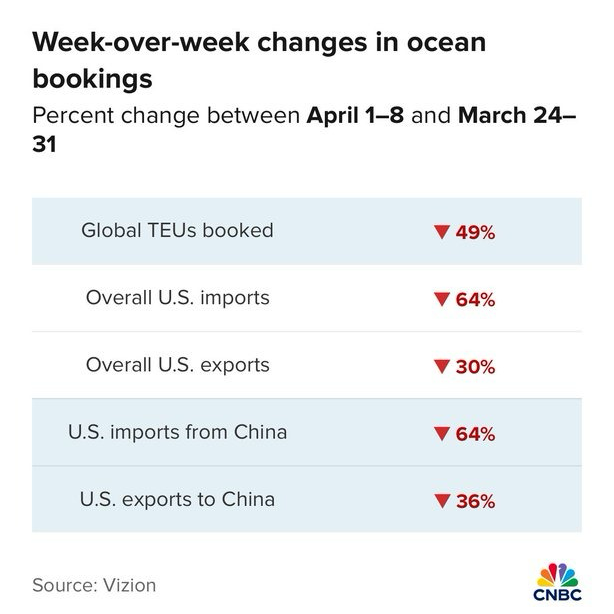
Figure 1: Data from Vizion API (tracking over 70% of global TEU bookings) shows a ~49% plunge in global weekly container volumes in early April 2025, signaling an acute trade freeze triggered by new US-China tariffs (Vizion API, 2025).]
Like a canary falling silent in a toxic mine, the abrupt collapse of global shipping volumes in early April 2025 served as an undeniable economic alarm. Reacting almost instantly to new US-China tariffs, the flow of goods seized up. Data from logistics intelligence firm Vizion API revealed:
Global TEU (Twenty-foot Equivalent Unit) bookings plummeted 49% week-on-week (April 1–8 vs. late March) (FreightWaves, 2025).
U.S. import bookings crashed by 64% (FreightWaves, 2025).
U.S. export bookings dropped 30% (FreightWaves, 2025).
Crucially, U.S. imports from China fell 64%, and exports to China slid 36% (FreightWaves, 2025).
While post-pandemic inventory cycles or China's uneven reopening rhythm may have contributed marginally, the scale and speed of the downturn map directly to the tariff announcements (FreightWaves, 2025). Businesses worldwide slammed the brakes, halting orders rather than risk absorbing duties reportedly reaching 145% and facing retaliatory levies up to 125% (J.P. Morgan Research, 2025).
Supply Chain Whiplash: Blank Sailings and Uncertainty
Ocean carriers reacted instantly, cancelling sailings en masse to prevent freight rates from collapsing entirely:
Drewry reported 83 blank sailings on key East-West routes in mid-April/May (a 12% cancellation rate, double the norm) (Drewry, 2025).
World Cargo News noted 198 total cancellations in March-April, far exceeding the prior year (World Cargo News, 2025).
This creates intense volatility for ports, truckers, and warehouses, disrupting logistics planning and adding costs throughout the supply chain. These trade tremors quickly translated into broader economic headwinds.
Economic Ripples: Growth Falters, Inflation Confuses
The WTO (World Trade Organization) slashed its 2025 trade growth forecast from +3.3% to –0.2%, warning of the sharpest contraction since COVID-19 (Reuters, 2025a; AP News, 2025). This trade drag directly impacts global growth forecasts. Tariffs add cost-push inflation on specific goods, yet the demand slowdown is deflationary, creating a confusing picture for central banks like the Federal Reserve (Reuters, 2025b). Before exploring policy solutions, let’s examine how these concurrent shocks hit the most vulnerable economies with devastating force.
The Compounded Crisis: Global South Crushed Between Tariffs and Aid Cuts
The true devastation lies where these two crises converge. For the Global South, it's a brutal 4-step cascade:
Tariffs & Slowdown → Lower Global Growth → Weaker Commodity Demand/Prices.
Weaker Demand → Falling Export Revenues for Developing Nations → Currency Depreciation.
Currency Depreciation + Vanishing Aid (due to US cuts [Devex, 2025b]) → Soaring Costs for Imported Essentials (Food, Fuel, Medicine, Fertilizer).
Soaring Costs + Collapsed Aid Programs (Health clinics closing [Devex, 2025a], food aid halted, WASH programs suspended [Devex, 2025d]) → Humanitarian Catastrophe.
Human Impact - Voices from the Frontline
Uganda's Health System Under Strain: At a PEPFAR clinic outside Masaka, patients like Maria Nakyeyune received only a two-month ARV supply due to USAID cuts. "If the situation does not return to normal," she told Devex, "then I will not remain" (Devex, 2025a). This occurs as trade shocks risk weakening the currency, making imported drugs even costlier.
Kenya's Health Workers Abandoned: "I was the one who was paying the school fees... With that shock – now there’s no job at all," lamented 'H', a clinical officer in Nairobi, one of potentially tens of thousands losing jobs due to the USAID freeze (Devex, 2025c; The Lancet, 2025; Wired, 2025).
Rohingya Camps: From Bad to Worse: Already facing ration cuts, Rohingya refugees saw US-funded hospitals and WASH programs shut down (Devex, 2025d). Trade disruptions now threaten to raise costs for essential shelter materials, deepening the misery (The Guardian, 2025).
Vulnerable Regions Face Escalating Risks
Horn of Africa & Conflict Zones
Somalia is on the brink of a renewed hunger catastrophe: 4.4 million people (23 % of the population) are projected to face crisis‐level food insecurity (IPC Phase 3+) between April and June 2025, driven by drought, conflict, and soaring prices (WFP, 2025). A further 1 million individuals could slip into acute hunger in coming months as WFP funding shortfalls force rations to be cut by half (WFP, 2025). In Darfur, aid agencies warn that up to 500,000 displaced people face “imminent risk of dying from famine‐related causes” as insecurity blocks relief convoys (Reuters, 2024). Yemen and Syria likewise remain mired in protracted food crises, with local food systems collapsing under conflict, high import bills, and frozen humanitarian pipelines (OCHA, 2024).
Sub‑Saharan Africa
Across sub‑Saharan Africa, the twin blows of tariff‑driven trade shocks and U.S. aid freezes threaten balance‑of‑payments strains and service delivery. Fitch Ratings cautions that while sovereign credit ratings have so far held up, persistent U.S. aid suspensions could undermine fiscal stability in poorer nations like Ethiopia, Mozambique, and Uganda (Reuters, 2025a). UNICEF reports that 1.3 million children in Ethiopia and Nigeria may run out of therapeutic food by mid‑2025 as donor shortfalls bite (UNICEF/Reuters, 2025). The UN’s 2025 humanitarian appeal is only 60 % funded, leaving 117 million people without planned assistance—up from 307 million in need the previous year (UN, 2024).
South Asia (Bangladesh & Pakistan)
Export‑driven economies in South Asia are also reeling. The International Trade Centre warns that U.S. tariffs could slash Bangladesh’s apparel exports by USD 3.3 billion annually by 2029 if levies remain in place (ITC, 2025). Brand‐level data suggest a 20–30 % drop in purchase orders as buyers sideline high‑tariff suppliers (BHRRC, 2025). Reuters reports that garment order cancellations risk costing Bangladesh USD 6 billion in revenue this year, imperiling the livelihoods of 4 million workers (Reuters, 2025b). In Pakistan, shrinking remittances—already critical to foreign exchange—will further weaken the rupee and raise import costs for fuel and medicines (Reuters, 2025c).
Small Island Developing States (SIDS)
The Caribbean and Pacific SIDS juggle fragile tourism recoveries with soaring import bills. Although arrivals have rebounded toward pre‑pandemic levels, 87 % of operators report operating‑cost increases outpacing inflation—driven by higher freight and fuel expenses—which squeezes profit margins and fiscal space (Travel and Tour World, 2025). Many islands rely on imports for over 80 % of food and nearly all petroleum products; for example, Antigua’s 2024 food import bill exceeded USD 1.2 billion, leaving its balance of payments vulnerable to any spike in shipping rates (First Citizens, 2025).
As Pamela Coke‑Hamilton of the International Trade Centre warned in April 2025, “Sweeping tariff measures risk a 3–7 % decline in global trade and a 0.7 % drop in GDP, with small island states and fragile economies seeing the greatest fallout” (ITC, 2025).
Looming Recession Risks: A Further Threat Horizon
The combined impact of aggressive tariffs and collapsing aid significantly increases the risk of a broader economic downturn, potentially tipping fragile economies—and even some advanced ones—into recession. This isn't just a theoretical possibility; it's a downstream consequence with potentially devastating implications, especially for humanitarian funding and poverty reduction efforts:
Deepened Aid Cuts: Recessions invariably lead to tighter government budgets in donor countries. If Western economies contract, the already dwindling political will to fund foreign assistance could evaporate further. Proposed cuts could become permanent, and even currently committed funds might face rescission. Humanitarian ODA (Official Development Assistance), often seen as discretionary, would likely be among the first casualties.
Reduced Philanthropic Giving: Economic downturns typically depress charitable giving. Foundations may see their endowments shrink, reducing their grantmaking capacity. Individual and corporate donations, crucial for many NGOs, often decline sharply during recessions as households and businesses tighten their belts.
Increased Poverty & Inequality: A global recession would disproportionately harm the Global South, reversing progress on poverty reduction. Job losses in export sectors, falling remittances, and reduced access to credit would push millions more into extreme poverty, increasing the scale of humanitarian need precisely when resources are scarcest.
Setbacks in Climate Action & Resilience: Recessionary pressures often lead governments and businesses to postpone investments in climate mitigation and adaptation, viewing them as unaffordable luxuries. This is particularly dangerous for climate-vulnerable nations in the Global South, which rely on international finance (already threatened by aid cuts) to build resilience against climate shocks.
Heightened Instability: Economic hardship fuels social unrest and political instability. A recession layered onto existing crises could trigger new conflicts or exacerbate ongoing ones, further increasing humanitarian needs and making aid delivery even more difficult and dangerous.
In essence, a recession triggered or worsened by the current trade shocks would create a vicious cycle: shrinking resources confronting escalating needs, potentially leading to a prolonged period of global instability and humanitarian suffering.
Navigating the Storm: Urgent Policy Adaptation Imperatives
Faced with this perfect storm and the looming threat of recession, immediate action and strategic adaptation are critical:
Top Policy Priorities (Advocacy Focus)
Protect Core ODA & Mandate Flexibility Congress must shield humanitarian Official Development Assistance (ODA) accounts—International Disaster Assistance, Migration and Refugee Assistance, Global Health Security—from proposed FY 2026 cuts and any rescissions package, preserving at least FY 2025 funding levels for these life‑saving programs. It should also mandate explicit appropriations language granting implementing partners the authority to reprogram funds to cover verified cost increases triggered by U.S. tariff‑induced import price shocks.
Secondary Policy Actions
Pre‑activate MDB/IMF Liquidity Rather than wait for a full‑blown crisis, G20 finance ministers should pre‑authorize and front‑load emergency liquidity lines by Q3 2025:
Channel USD 15 billion of 2021 SDRs into the IMF’s Poverty Reduction and Growth Trust (PRGT) and Resilience and Sustainability Trust (RST) by June 2025, bolstering low‑income members’ FX buffers.
Ensure the IMF’s Rapid Financing Instrument (RFI) and Rapid Credit Facility (RCF) are fully funded and pre‑authorized for up to USD 20 billion in quick‑disburse balance‑of‑payments support, cutting approval timelines from months to days.
Leverage hybrid‑bond authority to channel SDRs into MDB capital bonds—unlocking USD 80 billion in additional lending capacity—through an IMF‑approved mechanism by Q3 2025.
Pre‑authorize the World Bank’s Crisis Response Window (CRW) for a dedicated USD 10 billion envelope to finance essential food and fuel imports, with activation upon early‑warning triggers.
These measures will shore up foreign‑exchange reserves, close looming food‑and‑fuel funding gaps, and send a clear signal to markets and governments that support is already in place—thereby mitigating panic and averting deeper downturns.
Trade De‑escalationThe United States should pivot from unilateral tariffs to a rules‑based rollback:
Revive WTO Dispute Settlement Consent to re‑appoint Appellate Body judges so the WTO’s appeals mechanism can function again, as urgently urged by former and current WTO leaders “to preserve rule‑based trade”
Engage in Pending Cases Promptly enter consultations under GATT Article XXII with China and Canada to demonstrate U.S. commitment to legal dispute resolution rather than tit‑for‑tat tariffs.
Negotiate Phased Rollbacks Open structured talks with key allies (EU, Japan) to agree on six‑month sunset clauses and joint monitoring, ensuring any tariff rollbacks are predictable and enforceable.
Note: All indications are that the current U.S. administration has no plans to pursue this de‑escalation agenda—unless the dollar weakens sharply or a bond‑market panic forces a dramatic policy reversal.
Humanitarian & Development Sector Adaptation: Strategies for Survival and Resilience
The unprecedented dual shock of collapsing US aid and fractured global trade demands more than incremental adjustments; it requires a fundamental adaptation by the humanitarian and development sector. Survival necessitates embracing new operational realities, prioritizing ruthlessly, and innovating under extreme pressure. Key strategies include:
Radical Collaboration & Consolidation: The current fragmented ecosystem is unsustainable. Organizations must actively share resources, operational data (where ethically appropriate), and logistical platforms. Explore deeper strategic partnerships with clear divisions of labor and consider mergers as a viable path to preserve capacity and reduce overhead. Survival may depend on pooling resources rather than competing for shrinking funds.
Laser Focus on Core Life-Saving: In this era of scarcity, the mandate must contract. Prioritize interventions demonstrably preventing imminent death and alleviating acute suffering – emergency food/nutrition, basic health services (including essential WASH), emergency shelter, and critical protection from violence. This requires making agonizing choices and potentially scaling back or exiting longer-term development, resilience-building (unless directly tied to immediate survival), and broader advocacy programs.
Ruthlessly Streamline Operations and Cut Overhead: In this resource-scarce environment, every non-essential cost must be eliminated. Conduct immediate, rigorous reviews of all administrative and operational overheads. Simplify internal processes, reporting requirements, and management structures to maximize the proportion of funding reaching beneficiaries. This includes critically evaluating travel, office space, and non-programmatic expenditures to ensure every dollar is directed towards maximum life-saving impact.
Champion Cost-Efficient Delivery: Prioritize Cash Assistance (CVA): Where market analysis confirms feasibility and appropriateness, make Cash and Voucher Assistance (CVA), especially digital cash transfers, the default modality for meeting basic needs. CVA is proven to be highly cost-effective, upholds recipient dignity and choice, and directly stimulates local economies often reeling from concurrent trade shocks. Actively resist reverting to potentially less efficient in-kind distribution models unless context explicitly demands it, thereby stretching limited funds further [cite: calp-glossary-english.pdf].
Invest in Shared Digital Tools for Coordination & Tracking: Actively support, adopt, and invest in Digital Public Goods (DPGs) and data interoperability standards across the sector. In the face of fragmented funding, partner withdrawals, and chaotic transitions, shared digital infrastructure is no longer optional—it's essential. These tools are critical for effective coordination among remaining actors, reducing duplication, tracking beneficiary assistance across different agencies to prevent gaps or overlaps, and ensuring aid reaches the intended people efficiently, even as the operational landscape shifts unpredictably.
Empower Local Systems & Partners: With international capacity shrinking, invest remaining flexible funds strategically in strengthening the resilience and operational capacity of local NGOs and civil society organizations. Shift towards providing support, technical assistance, and core funding to enable them to lead responses where possible, recognizing they are often the first and most enduring responders, though they too are deeply affected by the crisis.
Prioritize Strategic Handover to National Systems & Preserve Data: Where feasible and appropriate, proactively plan for the transition of humanitarian programs, particularly beneficiary registration and targeting data, to existing government social protection systems. This is crucial to ensure that critical information and lessons learned are not lost during rapid shutdowns forced by funding cuts. A planned handover, even under duress, is vastly preferable to an abrupt exit that leaves beneficiaries unregistered and forces future responses to start from scratch, wasting precious resources and institutional memory. This requires early engagement with national authorities and investment in data portability and system alignment.
Conclusion: Weathering the Perfect Storm – A Call for Resilience
The canary in the global economic coal mine isn't just coughing; it's suffocating. The convergence of aggressive US tariffs disrupting trade and the simultaneous, deliberate dismantling of US foreign aid has unleashed a perfect storm. This dual shock is actively crushing vulnerable economies, paralyzing life-saving programs, and threatening to reverse decades of development progress, with the looming specter of recession promising even greater hardship. The human cost – measured in rationed medicines, lost jobs, and deepening hunger – demands an urgent response.
Will we let this perfect storm sink entire economies and abandon millions to despair, or will we galvanize a coordinated response focused on de-escalation, targeted relief, and resilient adaptation? The answer lies in our next policy moves and our collective capacity for change.
Share your perspectives:
For Aid Practitioners & NGOs: How are you adapting programming and seeking funding amidst this dual crisis? What support do you most need?
For Policy Experts & Advocates: Which specific tariff carve-outs or aid protection measures are most achievable and impactful right now?
For Business & Logistics Leaders: How can supply chain resilience be bolstered for essential humanitarian goods amidst this volatility?
Join the conversation below. Collective insight, advocacy, and action are paramount to navigating this unprecedented global challenge.
References
AP News (2025) ‘WTO says global trade could slide this year because of Trump’s tariff policies’, AP News, 16 April. Available at: https://apnews.com/article/0dfd480d5cee52ff39b369b7c781695d (Accessed: 17 April 2025).
BHRRC (2025) Impact of Tariffs on Bangladesh’s Apparel Sector, Business & Human Rights Resource Centre, 5 April. Available at: https://www.business-humanrights.org/en/latest-news/impact-of-tariffs-on-bangladeshs-apparel-sector/ (Accessed: 17 April 2025).
Devex (2025a) ‘A month after stop-work order, Uganda’s HIV response in chaos’, Devex, 20 February. Available at: https://www.devex.com/news/a-month-after-stop-work-order-uganda-s-hiv-response-in-chaos-109437 (Accessed: 17 April 2025).
Devex (2025b) ‘Nearly 10,000 awards cut from USAID, State Department’, Devex, 26 February. Available at: https://www.devex.com/news/nearly-10-000-awards-cut-from-usaid-state-department-109517 (Accessed: 17 April 2025).
Devex (2025c) ‘Thousands of African health workers lose jobs due to US aid funding freeze’, Devex, 15 March. Available at: https://www.devex.com/news/thousands-of-african-health-workers-lose-jobs-due-to-us-aid-funding-freeze-109600 (Accessed: 17 April 2025).
Devex (2025d) ‘USAID freeze deepens Rohingya crisis, exacerbating subhuman conditions’, Devex, 3 March. Available at: https://www.devex.com/news/usaid-freeze-deepens-rohingya-crisis-exacerbating-subhuman-conditions-109415 (Accessed: 17 April 2025).
Drewry (2025) ‘Cancelled Sailings Tracker: Weeks 16–20’, Drewry, 11 April. Available at: https://www.drewry.co.uk/maritime-research (Accessed: 17 April 2025).
First Citizens (2025) Tourism in the Caribbean, First Citizens Group, 14 March. Available at: https://www.firstcitizensgroup.com/lc/2025/03/14/tourism-in-the-caribbean-2/ (Accessed: 17 April 2025).
FreightWaves (2025) ‘“Tariff shockwave” leads to collapse in ocean container bookings’, FreightWaves, 9 April. Available at: https://www.freightwaves.com/news/tariff-shockwave-leads-to-collapse-in-ocean-container-bookings (Accessed: 17 April 2025).
ITC (2025) ‘Tariff Wars Threaten Bangladesh Exports’, International Trade Centre, 11 April. Available at: https://www.intracen.org/news/Tariff-wars-threaten-Bangladesh-exports/ (Accessed: 17 April 2025).
J.P. Morgan Research (2025) ‘U.S. Tariffs: What’s the Impact?’, J.P. Morgan (internal report, April 2025).
NPR (2025) ‘Nearly all USAID programs have been cut by the Trump administration’, Goats and Soda, NPR, 26 February. Available at: https://www.npr.org/sections/goats-and-soda/2025/02/26/nx-s1-5310673/usaid-trump-administration-global-health (Accessed: 17 April 2025).
OCHA (2024) Somalia: Drought, Conflict and High Food Prices Risk Pushing 4.4 Million People into Hunger, United Nations Office for the Coordination of Humanitarian Affairs, 26 February. Available at: https://www.unocha.org/publications/report/somalia/drought-conflict-and-high-food-prices-risk-pushing-44-million-people-hunger (Accessed: 17 April 2025).
Politico (2025) ‘Trump weighs slashing State Department budget by nearly half’, Politico, 14 April. Available at: https://www.politico.com/news/2025/04/14/trump-state-department-budget-00289269 (Accessed: 17 April 2025).
Reuters (2024) ‘Displaced in Darfur Face Imminent Famine Risk, Aid Agencies Warn’, Reuters, 4 April. Available at: https://www.reuters.com/world/africa/displaced-in-darfur-face-imminent-famine-risk-aid-agencies-warn-2024-04-04/ (Accessed: 17 April 2025).
Reuters (2025a) ‘African Credit Ratings Can Absorb Aid Cuts and Trade Strains, Fitch Says’, Reuters, 10 April. Available at: https://www.reuters.com/world/africa/african-credit-ratings-can-absorb-aid-cuts-trade-strains-fitch-says-2025-04-10/ (Accessed: 17 April 2025).
Reuters (2025b) ‘Bangladesh Faces $6 Billion Revenue Hit from Garment Order Cancellations’, Reuters, 7 April. Available at: https://www.reuters.com/world/bangladesh-faces-6-billion-revenue-hit-from-garment-order-cancellations-2025-04-07/ (Accessed: 17 April 2025).
Reuters (2025c) ‘Pakistan Remittances to Fall as Diaspora Income Shrinks’, Reuters, 10 April. Available at: https://www.reuters.com/world/asia/pakistan-remittances-to-fall-as-diaspora-income-shrinks-2025-04-10/ (Accessed: 17 April 2025).
Reuters (2025d) ‘WTO slashes 2025 trade growth forecast, warns of deeper slump’, Reuters, 16 April. Available at: https://www.reuters.com/markets/wto-slashes-2025-trade-growth-forecast-warns-deeper-slump-2025-04-16/ (Accessed: 17 April 2025).
Reuters (2025e) ‘Fed winning with its “cruel-to-be-kind” strategy’, Reuters, 17 April. Available at: https://www.reuters.com/markets/us/fed-winning-with-its-cruel-to-be-kind-strategy-mike-dolan-2025-04-17/ (Accessed: 17 April 2025).
The Guardian (2025) ‘Charities reeling from USAid freeze warn of ‘life or death’ effects’, The Guardian, 28 January. Available at: https://www.theguardian.com/global-development/2025/jan/28/charities-reeling-from-usaid-freeze-warn-of-life-or-death-effects (Accessed: 17 April 2025).
The Lancet (2025) ‘Health worker lay-offs in east Africa following US aid freeze’, The Lancet, 8 February. Available at: https://www.thelancet.com/journals/lancet/article/PIIS0140-6736(25)00234-X/fulltext (Accessed: 17 April 2025).
Travel and Tour World (2025) ‘Caribbean Tourism Industry Achieves Remarkable Success Despite High Costs’, Travel and Tour World, 15 March. Available at: https://www.travelandtourworld.com/news/article/caribbean-tourism-industry-achieves-remarkable-success-in-despite-high-taxes-and-inflation/ (Accessed: 17 April 2025).
UN (2024) Global Humanitarian Overview 2025, United Nations, 24 December. Available at: https://www.unocha.org/sites/unocha/files/GHO2025.pdf (Accessed: 17 April 2025).
UNCTAD (United Nations Conference on Trade and Development) (2023) Global Trade Update December 2023, UNCTAD, 15 December. Available at: https://unctad.org/system/files/information-document/ditc_inf_2023d3_en.pdf (Accessed: 17 April 2025).
UNICEF (2025) ‘Somalia: Drought, Conflict and High Food Prices Could Push 4.4 Million into Hunger’, UNICEF, 26 February. Available at: https://www.unicef.org/somalia/press-releases/somalia-drought-conflict-and-high-food-prices-could-push-44-million-people-hunger (Accessed: 17 April 2025).
Vizion API (2025) ‘Tariff Shockwave: U.S. Import Bookings Collapse After Q1 Surge’, Vizion API, 11 April. Available at: https://www.vizionapi.com/blog/tariff-shockwave-us-import-bookings-collapse-after-q1-surge (Accessed: 17 April 2025).
WFP (2025) ‘Somalia: Drought, Conflict and High Food Prices Risk Pushing 4.4 Million People into Hunger’, World Food Programme, 26 February. Available at: https://www.wfp.org/news/somalia-drought-conflict-and-high-food-prices-risk-pushing-44-million-people-into-hunger (Accessed: 17 April 2025).
Wired (2025) ‘The USAID Shutdown Puts Millions of African Lives at Risk’, Wired, 10 March. Available at: https://www.wired.com/story/the-usaid-shutdown-puts-millions-of-african-lives-at-risk (Accessed: 17 April 2025).
World Cargo News (2025) ‘US tariff worries drive spike in blank sailings’, World Cargo News, March 2025. Available at: https://www.worldcargonews.com/news/us-tariff-worries-drive-spike-in-blank-sailings (Accessed: 17 April 2025).
Yahoo Finance (2025) ‘Mark Carney warns the 80-year period of US economic leadership is over’, Yahoo Finance, 3 April. Available at: https://finance.yahoo.com/news/mark-carney-warns-80-period-100400825.html (Accessed: 17 April 2025).
Enjoyed this article?
This post is from Aid and Dev Dispatches, a LinkedIn newsletter with expert analysis on humanitarian reform, AI adoption, crisis economics, and the politics of aid. Join 9,000+ subscribers.